How to Choose an AI Automation Agency
Published . Updated .
AI means artificial intelligence. An AI automation agency connects software and AI to business tasks. Its scope can include design, delivery, support, or continuing operation. The label alone does not tell a buyer which services the agency provides.
Compare the contract, tests, controls, and support arrangements. Ask what happens when a run fails or the provider becomes unavailable. Clear answers matter more than a polished demonstration.
What should the agency deliver?
A useful automation handles the task and its likely exceptions. An exception is a case that needs special handling or review. The work can include input checks, access limits, activity records, alerts, documentation, and staff training.
Start with a task that has a clear owner and a measure of success. Examples include document processing, request routing, and record updates. Check whether existing software already performs the task before buying a custom build.
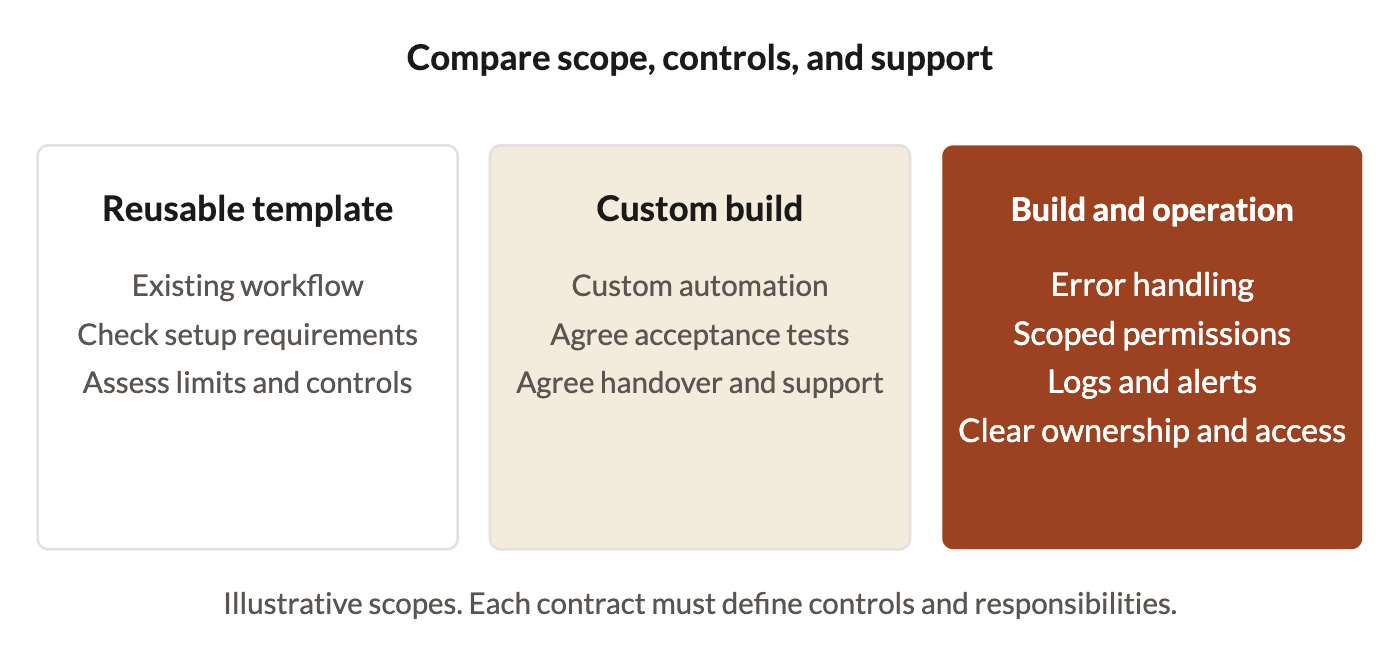 These are purchase scopes, not ratings of every agency.
Which questions should a buyer ask?
| Ask | Evidence to request | Warning sign |
|---|---|---|
| What happens when a run fails? | Safe retry rules, alerts, activity records, and an exception owner | No failure plan |
| Who hosts it and controls access? | Agreed hosting, documented access rights, and continuity terms | Undocumented personal accounts or unclear access |
| What actions can it take? | Limited permissions and approval rules for consequential actions | Broad access without a reason |
| How do you test it? | Real cases, incomplete inputs, and acceptance criteria | A demonstration without representative tests |
| How do we measure success? | An agreed measure, such as time, errors, or completion rate | Benefits without a baseline |
| What happens if the provider leaves? | Ownership terms, documentation, and a support or transition plan | Essential knowledge with one person |
| Which task comes first? | A valuable task with a defined scope | A large package without priorities |
Provider-managed hosting can be appropriate. It does not mean the customer must own every infrastructure account. The contract must define ownership of the work, permitted access, operating responsibilities, and continuity.
Why does reliability need attention?
S&P Global reports that organisations scrap an average of 46% of AI proofs of concept before production. A proof of concept tests whether an idea can work. This reported average does not describe every agency or project. S&P Global research
In July 2024, Gartner forecast abandonment of at least 30% of generative AI projects after proof of concept by end-2025. It named poor data quality, weak risk controls, rising costs, and unclear business value. This was a forecast, not an observed agency failure rate. Gartner forecast
Multiple steps can also reduce overall success. Consider five independent steps, each with a 95% chance of success. If every step must succeed, task success is about 77%. This illustration assumes no retries or recovery. Real systems need their own measurements. Why AI Agents Break After the Demo explains these checks.
How Chiri approaches this. Chiri builds, operates, and improves company-specific software as an AI managed service provider. Small teams of senior operators and engineers work with the customer. Chiri supports permissions, activity records, and shared context through its platform. The customer and Chiri agree ownership, hosting, and operating responsibilities. See Chiri's services
When does outside help make sense?
Outside help can suit a clear task when the internal team lacks capacity or relevant expertise. Compare the expected benefit with delivery and ongoing operating costs. Include the staff time needed for review and exceptions.
A changing work process does not automatically rule out automation. It can require regular maintenance and closer support. Ask how the provider prices and handles those changes.
Pause the build when necessary controls or a clear owner are missing. Resolve those gaps before the system takes consequential actions. Start with a limited scope and expand after the evidence meets your acceptance criteria.
How does continuing operation differ from a one-time build?
A one-time build provides agreed delivery and handover. Continuing operation adds monitoring, maintenance, incident handling, and improvements. Agencies can offer either service. Check the agreement rather than assuming the label defines the scope.
Chiri's The Return of the MSP explains the managed service provider model. A managed service provider takes agreed responsibility for operating systems over time.
Use the seven questions to compare proposals and identify missing terms. Talk to Chiri.
Questions and answers
How can a buyer assess an AI automation agency?
Request tests, failure handling, access terms, and a support plan. Compare those items with the task and its risks. The agency label alone does not establish quality.
Must the automation run in the customer's accounts?
Not always. Provider-managed hosting can be appropriate. Agree ownership, access, support, and continuity in the contract.
Should the first project cover one task or many?
A limited scope makes testing and measurement easier. Expand when results meet the agreed criteria. Keep necessary human review in place.
Can an agency offer ongoing operation?
Yes. Agencies can provide a one-time build, continuing support, or both. Confirm the exact responsibilities and service terms.