AI Readiness Assessment: Six Practical Checks
Published . Updated .
AI means artificial intelligence. An AI readiness assessment checks the requirements for a proposed system before a company commits to delivery. A use case describes the specific task that the system will perform. Assess that task alongside company-wide security, governance, capacity, and investment needs.
Chiri recommends six practical checks: problem, data, definitions, systems, controls, and people. This is a planning framework, not a validated prediction of project success. Gartner and Cisco research provide wider context. They do not validate this specific six-check framework.
What does the research show?
Gartner surveyed 1,203 data management leaders in July 2024. It found that 63% lacked the right data management practices for AI or were unsure about those practices. This describes practices, not proof that 63% lack the data itself. Gartner also forecast abandonment of 60% of AI projects without AI-ready data through 2026. That figure is a forecast for a specified group, not an observed failure rate for all AI projects. Gartner data research
Cisco's 2025 AI Readiness Index surveyed 8,039 senior leaders from organisations with at least 500 employees. Its framework placed 13% in its highest readiness category, called Pacesetters. This does not mean that only 13% of all companies can use AI. The classification depends on Cisco's sample and assessment method. Cisco findings
Why assess a specific task?
A company can meet the requirements for one task and lack them for another. Invoice matching and customer support can involve different data, permissions, and review requirements. A broad maturity score does not answer every project question.
Company-wide assessments still help with investment priorities, shared infrastructure, governance, and staff skills. Use them with task-specific checks. Do not treat these two assessment levels as alternatives.
What should the six checks cover?
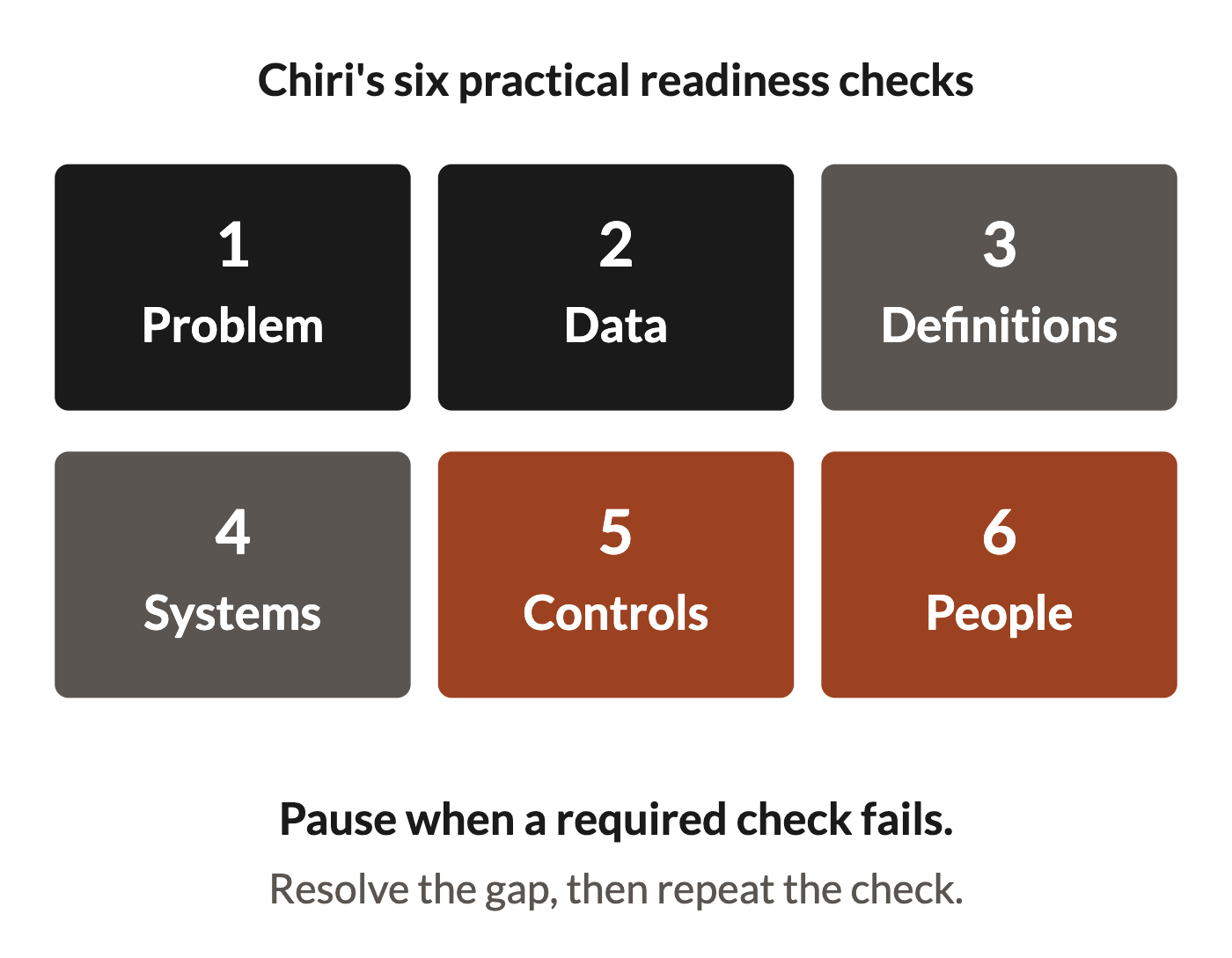 A practical planning framework. Resolve required gaps before delivery.
| Check | Question | Gap to resolve |
|---|---|---|
| Problem | Which task, measure, and owner define success? | No agreed goal, owner, or baseline |
| Data | Are the required sources current, permitted, and usable? | Unknown quality, missing access, or incomplete records |
| Definitions | Do the teams agree the key terms? | Conflicting meanings for important business terms |
| Systems | Can the system use approved connections? | Missing integration or unapproved manual transfers |
| Controls | Which actions need permission, review, and records? | Unclear approval rules or activity records |
| People | Can users complete the task with the new system? | No user involvement, training, or support plan |
An approved connection can use an application programming interface (API). An API lets software exchange data or request actions. A manual step can remain appropriate when a reviewer needs to make a decision. Assess its purpose and cost rather than rejecting every manual step.
How should the team act on the result?
- Proceed: Required checks meet the agreed criteria. Start with a limited scope and measure the result.
- Resolve gaps: Assign an owner and date for each required fix. Repeat the affected checks before delivery.
- Pause or choose another task: The goal, data, controls, or expected value cannot support delivery yet.
A failed data or ownership check does not require permanent abandonment. The team can resolve the gap and reassess. Choose another task when remediation cannot justify its cost or risk.
How Chiri approaches this. Chiri's small teams of senior operators and engineers work with the customer's team. They map data, definitions, systems, and controls for a specific task. Chiri Brain stores shared definitions and context. Each new task still needs its own assessment. See Chiri Brain
How long should an assessment take?
A focused assessment can take days when data access and the required people are available. Complex integrations, regulated records, or company-wide scope can take longer. Agree the scope, evidence, review dates, and expected decision before starting.
The output should identify requirements, unresolved gaps, owners, and a next decision. An assessment does not need to promise production delivery to provide value.
Who should run the assessment?
Include the process owner, users, engineering, data, and security representatives as needed. The team needs relevant delivery experience and access to real examples. Internal staff or an outside team can lead the work.
An outside builder can contribute useful technical knowledge. It also has a commercial interest in the next project. Use clear acceptance criteria and independent review for important decisions.
Read Where AI Rollouts Go to Die for organisational risks. See What Real AI Agent Governance Looks Like in Practice for control design.
Define the task and the evidence needed for a delivery decision. Talk to Chiri or see Chiri's services.
Questions and answers
What is an AI readiness assessment?
It checks the requirements for a proposed AI task or programme. A useful assessment identifies gaps, owners, and the next decision.
Does data cause most readiness failures?
The cited research does not establish that ranking for this framework. Data quality and management practices need review alongside controls, systems, ownership, and adoption.
Is a company-wide maturity assessment useful?
Yes, for priorities, shared infrastructure, governance, and staff skills. Combine it with the requirements of the specific task.
What does Cisco's 13% figure mean?
Cisco classified 13% of its surveyed organisations as Pacesetters. The sample covered organisations with at least 500 employees. It does not represent every company.
Does a failed check mean the project must stop permanently?
No. Pause delivery, resolve the gap, and repeat the check. Choose another task when the expected value cannot justify remediation.