How to Give AI Agents Secure Access to Company Knowledge
Published . Updated .
Give AI agents secure knowledge access by checking each requesting user’s permissions before supplying documents to the model. Trace the document path, assign accountable owners, and test permitted and forbidden access before launch. Treat this as a configuration and operating responsibility, not simply a connector purchase.
For buyers, the key question is who can demonstrate those controls in your intended setup. Use this approach as an evaluation and launch plan, not a security guarantee.
Where does a document travel before the agent answers?
Start with one representative document, such as a restricted pricing proposal. Ask your implementation team to trace every copy from its original repository to the agent’s response.
For this illustrative map, use these working labels, not universal architecture definitions. Call the source connection a connector, and any searchable content representation an index. Call information selection retrieval, and information supplied to the model model context. Ask the team to replace these labels with your system’s components.
As a storage-review task, inventory document text, excerpts, permissions, identifiers, response history, and logs. Include any caches; here, that working label means stored information kept for reuse. Ask who can read each location and how deletion reaches each copy.
Do not accept “the connector respects permissions” as the whole explanation. Request a diagram showing where the system checks access and whose identity it checks.
Which permissions must survive the journey?
Ask which source rules apply, including individual access, group membership, folder inheritance, and restrictions. For inherited permissions, ask which folder relationships grant access in this repository. Have the configurator demonstrate how retrieval preserves those relationships and handles changes; do not assume every repository behaves alike.
Box’s developer documentation states: “Hub access does not replace file permissions.” It also says: “If you export content, your pipeline must enforce Box permissions.” These statements describe Box’s documented workflow and export responsibilities, not every knowledge connector.
Auth0’s authorization guidance states: “Unauthorized documents are filtered out. The LLM receives only authorized context.” LLM means large language model. Use that boundary as an evaluation requirement: check access before supplying content, rather than relying on answer-writing instructions.
Ask what happens when the system cannot resolve identity or permissions. Require an explicit decision about denying access, rather than leaving that behavior implicit.
Who should configure and review access?
Choose a team that can explain both repository permissions and the agent’s retrieval path. Assign four responsibilities, even when one person holds several roles:
- Source owner: Approves included documents and confirms which users should access them.
- Implementation owner: Configures connector identities, indexing, retrieval checks, and permission updates.
- Security reviewer: Challenges the design and reviews denied-access results independently of implementation.
- Operational owner: Handles access changes, failures, incident response, and recurring tests after launch.
Keep source access approval with your organization, even when a provider performs configuration. Ask prospective providers for a sample access map, test record, and handover document. Prefer demonstrated answers over broad assurances about enterprise security.
For product context, consult the Chiri platform overview. Use it alongside configuration-specific evidence, not as proof that your access requirements already hold.
How should you test access before launch?
Use representative accounts and approved test documents. Give one account access to a restricted document and deny another account access. Ask both accounts identical factual questions, including questions that paraphrase the document rather than name it.
Check retrieved passages and supplied model context, not just the visible answer. Include citations, document titles, snippets, and previous conversation content in the review. Record the expected result, actual result, requesting identity, configuration version, and responsible reviewer.
Next, revoke access at the source and repeat the tests. Test group removal, folder moves, document deletion, and permission-update failures. Agree on an acceptable propagation time: the delay before source changes affect agent access. Measure that delay in your setup rather than assuming immediate updates.
If the agent can send messages or update records, test those actions separately. Read permission should not serve as blanket approval for downstream actions. The AI harness explainer provides related context on controls around agent tools and actions.
What should remain in place after launch?
Require access-decision records that identify the requester, document, decision, and time without unnecessarily duplicating sensitive content. Assign someone to review failures and investigate unexpected access. Treat these records as investigation aids, not proof that no unrecorded access occurred.
Repeat the test set after connector changes, identity changes, permission-model changes, or new repositories. Extend the review with the broader AI security checklist.
Set launch criteria requiring named owners to accept the access map, test results, unresolved limitations, and ongoing responsibilities. The buying decision should include who maintains these controls—not merely who connects the documents.
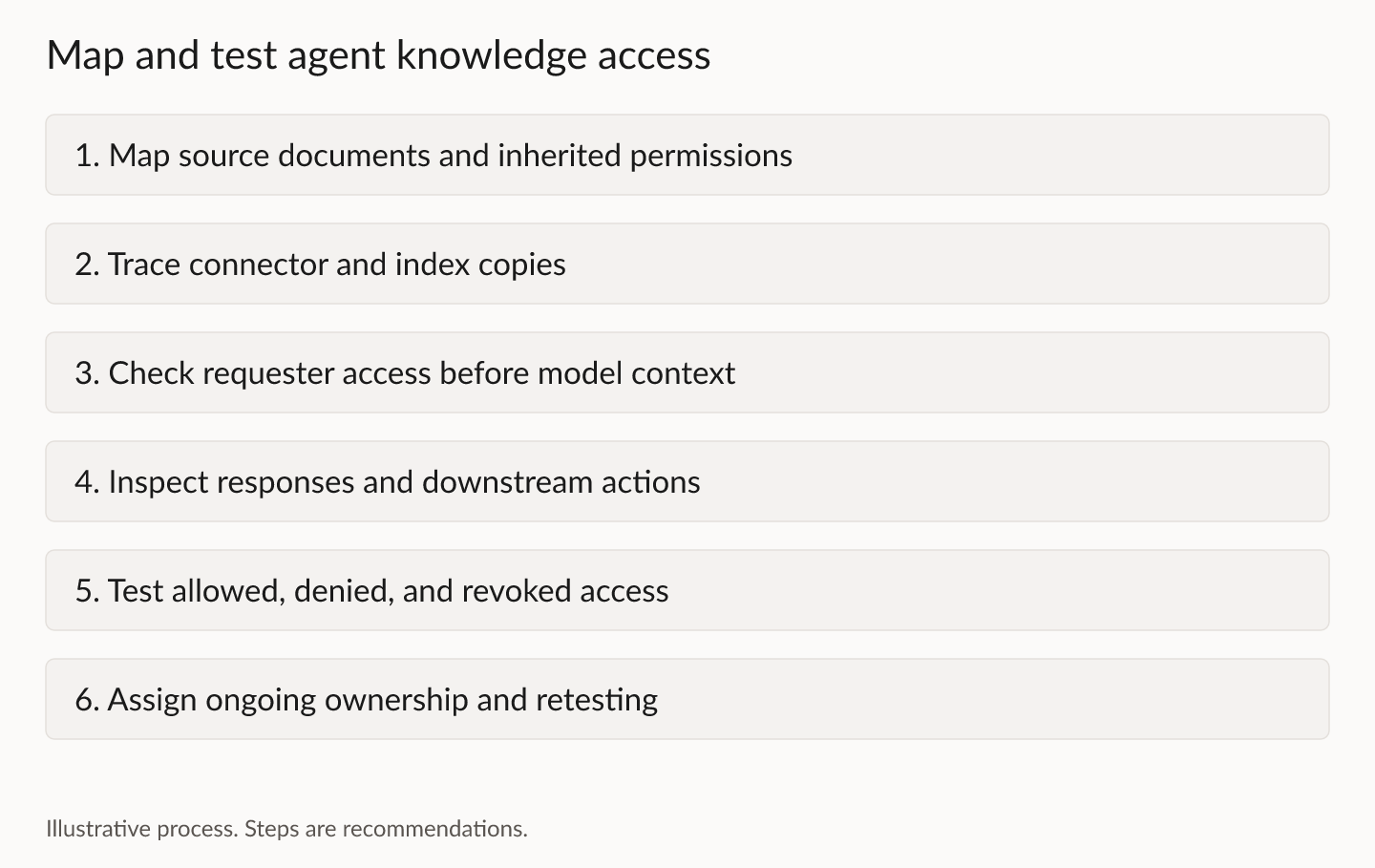
Trace document access, then test allowed, denied, and revoked requests.
- Map source documents and inherited permissions
- Trace connector and index copies
- Check requester access before model context
- Inspect responses and downstream actions
- Test allowed, denied, and revoked access
- Assign ongoing ownership and retesting