What Is a Forward Deployed Engineer?
Published . Updated .
A forward deployed engineer (FDE) works closely with customers to deliver software in their operating environment. The role combines software engineering with direct work on customer needs, data, systems, and adoption. Responsibilities vary by employer and contract. The title alone does not prove delivery quality.
AI means artificial intelligence. For AI projects, an FDE can help connect models to approved data and tools. The engineer also tests outputs, sets permissions, and resolves integration problems. Internal engineers and consulting teams can perform this work too.
What work does an FDE perform?
The engineer starts with the task that the customer needs to complete. That can require interviews, source checks, access reviews, software changes, and testing. Useful deliverables include working integrations, documented controls, and tests that cover real cases.
The Chiri delivery model uses small teams of senior operators and engineers. The model combines business understanding with technical delivery. It does not remove the need for a customer owner or agreed acceptance criteria.
How does an FDE differ from other roles?
These are common patterns, not fixed boundaries. A consultant can write production software. A solutions engineer can support deployment after a sale. An internal engineer can own the same customer outcome.
| Role | Common focus | What the buyer should check |
|---|---|---|
| Forward deployed engineer | Customer-specific implementation and adoption | Delivery scope, production responsibilities, and handover |
| Strategy consultant | Business cases, operating decisions, and advice | Whether advice or software is the agreed result |
| Solutions engineer | Product fit and technical implementation support | Whether the role continues after the sale |
| Internal engineer | The company's software and operating requirements | Available capacity and relevant delivery experience |
Compare the agreed work rather than the job title. Ask who owns testing, access controls, user adoption, and ongoing support. Agree how you will measure progress.
Does a company need FDE capability?
A clear, valuable problem in complex systems can justify an embedded engineering team. An embedded team works directly with the customer during delivery. Complexity can include old software, inconsistent data, regulated records, or several disconnected tools.
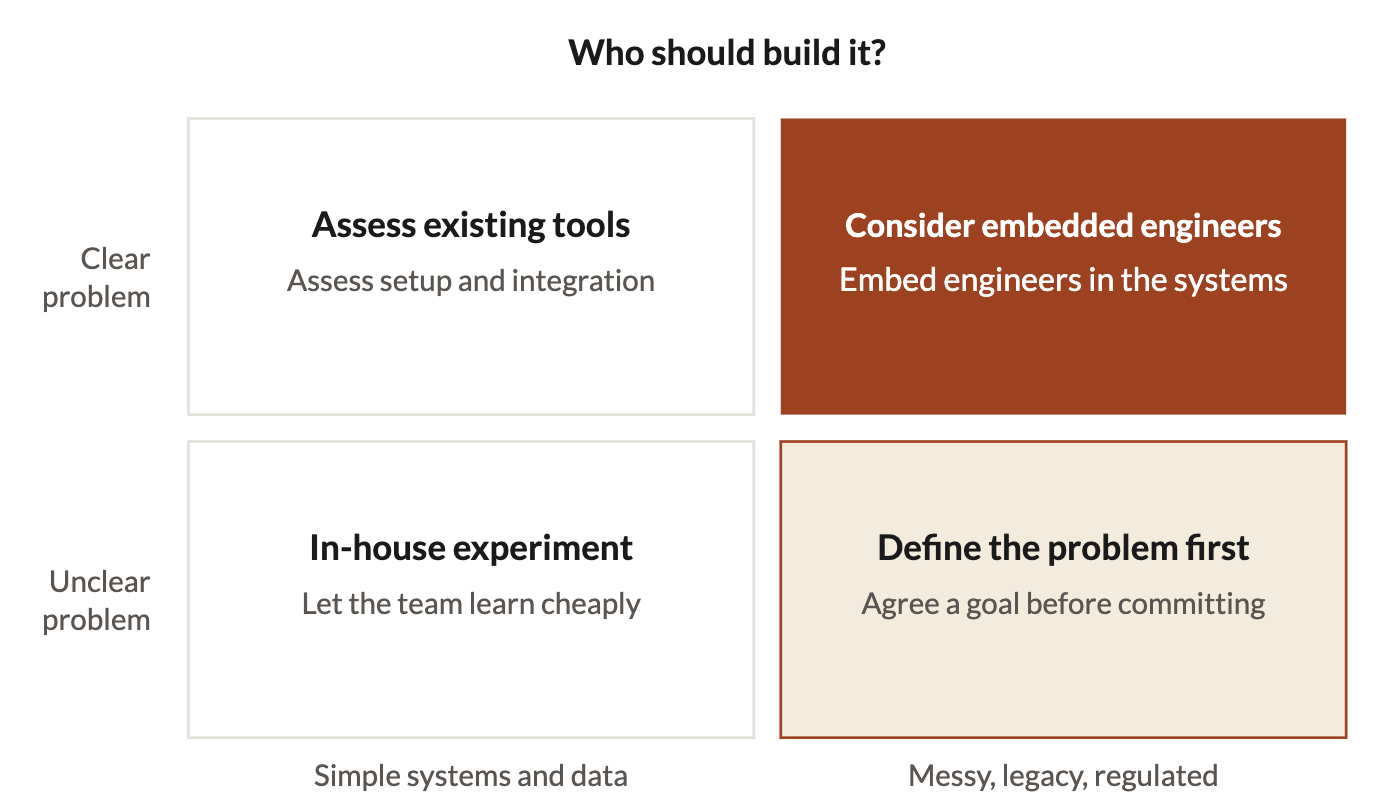 This guide compares options. It does not make the decision for every project.
An existing tool can be enough when it meets the task and control requirements. It can still need setup, integration, security review, and training. An experienced internal team can also deliver the work without outside engineers.
When the goal is unclear, define it before committing to a large build. A focused assessment or experiment can help. Discovery is valid work when the contract states its purpose and result.
What are the ways to obtain this capability?
| Option | Suitable conditions | Questions to ask |
|---|---|---|
| Internal engineers | Sustained work and available capacity | Does the team have the required experience and support? |
| A vendor's engineers | Deployment of that vendor's product | Which integrations and responsibilities does the vendor cover? |
| An outside embedded team | A capacity or expertise gap | Who owns the work, operates it, and retains the knowledge? |
How Chiri works. Chiri combines software delivery with continuing operation and improvement. Small teams of senior operators and engineers work with the customer. Chiri targets first production systems within weeks. Timing depends on scope, data, access, and required controls. Chiri Brain stores shared definitions and context. See Chiri's services
What should a company expect in the first weeks?
Agree milestones for understanding the task, checking data, confirming access, testing, and delivery. Ask for evidence at each review. That evidence can include tested integrations, access decisions, sample outputs, or a justified change in scope.
Some projects need substantial discovery or security work before production deployment. Documents alone do not prove failure when that work matches the agreement. They do indicate a mismatch when the agreement promises working software instead.
Plan continuing support before launch. Confirm ownership, access rights, operating responsibilities, and a process for changes. Do not leave essential context with one engineer.
Compare capability, scope, and accountability before choosing a delivery model. Talk to Chiri.
Questions and answers
What does a forward deployed engineer do?
The engineer works with customers on software implementation. The work can include data access, integration, testing, permissions, and user adoption. The exact scope depends on the employer and contract.
Is an FDE the same as a consultant?
The roles can overlap. Compare deliverables, production responsibilities, and support terms. A job title does not establish whether the team delivers advice or working software.
Should a company hire engineers or use an outside team?
Compare the expected workload, internal capacity, expertise, and continuing support needs. An internal team can suit sustained work. An outside team can address a specific capacity or expertise gap.
Does an existing tool remove the need for engineering?
Not always. The tool can still require configuration, integration, security review, and training. Check those needs before deciding who will deliver it.