What Is Shadow AI?
Published . Updated .
AI means artificial intelligence. Shadow AI is the use of AI tools that the company has not approved, such as staff pasting company documents into a personal chatbot account. IBM defines it this way:
"Shadow AI is the unsanctioned use of any artificial intelligence (AI) tool or application by employees or end users without the formal approval or oversight of the information technology (IT) department."
IBM, What is shadow AI?, October 2024
Shadow AI is rarely malicious, and it is usually a sign of demand. It usually means people found a tool that helps them work, and the company has not yet offered an approved alternative or set the rules. The risk is that company data leaves controlled systems without anyone knowing, and that no one can later say where it went.
How common is shadow AI?
Microsoft and LinkedIn's 2024 Work Trend Index, based on a survey of 31,000 people across 31 countries, found that 75% of knowledge workers use AI at work, and that "78% of AI users are bringing their own tools to work". Microsoft, May 2024 These figures are from 2024 and describe knowledge workers, not every employee.
A Gartner survey of 302 cybersecurity leaders, run from March to May 2025, found that 69% of organisations suspect or have evidence that employees are using prohibited public generative AI. Gartner also predicts that by 2030 more than 40% of enterprises will experience security or compliance incidents linked to unauthorized shadow AI. The first figure reflects what security leaders suspect, and the second is a forecast. Gartner, November 2025
What does shadow AI cost when something goes wrong?
IBM's Cost of a Data Breach Report 2025, conducted by the Ponemon Institute, studied breaches at 600 organisations. Among them, one in five reported a breach due to shadow AI. Organisations with high levels of shadow AI saw an average of $670,000 in higher breach costs than those with low levels or none. IBM, July 2025
Incidents involving shadow AI also exposed more sensitive data than the average breach in the study:
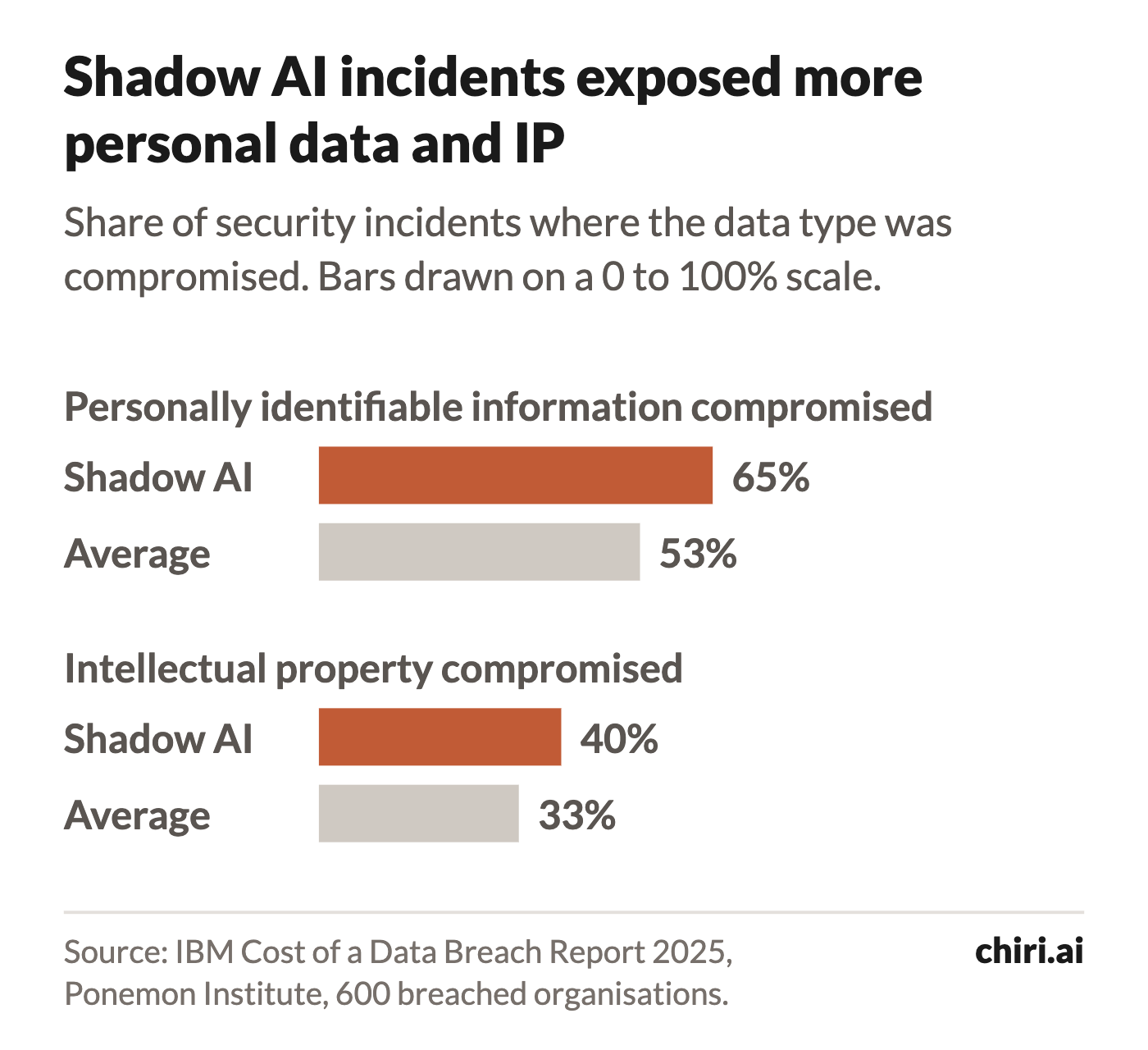 Breached organisations studied by IBM, not all companies.
Governance gaps were common. IBM found that 63% of breached organisations either had no AI governance policy or were still developing one. Of those with a policy, only 34% performed regular audits for unsanctioned AI. Chiri's The Actual Problem Isn't "AI." It's Everything Around AI. discusses the same report in the wider context of enterprise AI security.
"The data shows that a gap between AI adoption and oversight already exists, and threat actors are starting to exploit it."
Suja Viswesan, Vice President, Security and Runtime Products, IBM, July 2025
Why do employees use unapproved AI tools?
The usual reasons are practical. The approved tool does not exist yet, is hard to reach, or cannot do the task. A personal account is one click away. People also may not know which data is sensitive or where a public tool stores it. Chiri's Claude Cowork is having a moment describes a related risk: consumer AI plans handling company files.
A ban alone does not remove the need that created the behaviour. The response works best when it gives people an approved way to do the same task.
The risk also differs by data type. Drafting a generic email in a public tool carries little risk. Pasting customer records, contracts, source code or financial results does. A useful first step is a short list of data that must never go into an unapproved tool, written in plain language and shared with everyone.
How should a company respond?
| Response | What it involves | Why it helps |
|---|---|---|
| Offer an approved tool that works | A sanctioned AI assistant connected to the systems people already use | Removes the main reason to look elsewhere |
| Write a short usage policy | Which tools are allowed, which data may never go into public tools, who to ask | Gives staff a clear rule instead of a guess |
| Get visibility | Review which AI services are in use, through network, identity or expense records | You cannot manage what you cannot see |
| Set access controls | Limit which AI tools can reach which data, and log their use | Reduces what a single mistake can expose |
| Train and review | Short practical training, then regular audits for unsanctioned AI | Keeps the policy current as tools change |
Gartner's advice runs in the same direction:
"To address these risks, CIOs should define clear enterprise-wide policies for AI tool usage, conduct regular audits for shadow AI activity and incorporate GenAI risk evaluation into their SaaS assessment processes."
Arun Chandrasekaran, Distinguished VP Analyst, Gartner, November 2025
CIO means chief information officer. SaaS means software as a service, such as tools bought on subscription. Chiri's field guide to AI governance covers the policy side in more depth, and What Real AI Agent Governance Looks Like in Practice covers controls for AI agents.
How Chiri approaches this. Chiri builds, operates, and improves company-specific software as an AI managed service provider. Small teams of senior operators and engineers work with the customer. Chiri supports permissions, activity records, and shared context through its platform, so approved AI tools can reach company data under agreed controls. See AI harness and governance
Want approved AI tools your team will actually use? Talk to Chiri.
Questions and answers
What is shadow AI?
The use of AI tools or applications that the company has not approved and does not oversee, such as personal chatbot accounts used with company data.
Is shadow AI the same as shadow IT?
It is a type of shadow IT. The difference is that AI tools often receive the content of documents and conversations, so the data exposure can be larger.
How common is shadow AI?
In Microsoft and LinkedIn's 2024 survey, 78% of AI users said they bring their own AI tools to work. In a 2025 Gartner survey, 69% of security leaders suspected or had evidence of prohibited public AI use.
Should a company ban public AI tools?
A ban without an approved alternative leaves the original need in place. Pair any restriction with an approved tool, a clear policy and regular review.
What does shadow AI cost?
In IBM's 2025 study of 600 breached organisations, those with high levels of shadow AI saw an average of $670,000 in higher breach costs than those with low levels or none.