Why AI Pilots Fail in Finance
Published . Updated .
AI means artificial intelligence. Finance AI pilots can fail because of model errors, poor data, weak controls, or difficult work processes. Recorded balances and payment amounts need checked sources or checked calculations. Forecasts and risk estimates need a different test: clear assumptions, measured error, and appropriate review.
A language model generates text from patterns in data. It can produce a convincing but incorrect figure. Do not treat that answer as a ledger record. Separate recorded facts from estimates, and identify the source of each.
What does the adoption evidence show?
Gartner surveyed 183 chief financial officers and senior finance leaders in May and June 2025. Of those respondents, 59% reported AI use in their finance function. The reported shares were 58% in 2024 and 37% in 2023. Among AI adopters, 37% used accounts payable automation and 34% used anomaly detection. Accounts payable covers money that a company owes suppliers. Gartner finance survey
The survey describes adoption and reported uses. It does not establish one cause for pilot failure. It also does not prove that every implementation follows the same control pattern.
How should a finance system handle recorded figures?
Use checked records and calculations for balances, payment amounts, and financial reporting totals. Keep the source, calculation version, and approval record available for inspection. This is a recommended design pattern, not a rule for every kind of AI.
| Requirement | Risk to test | Recommended control |
|---|---|---|
| Correct recorded figures | The model invents or changes a figure | Retrieve checked records or run checked calculations |
| Source evidence | A fluent answer hides an unsupported number | Link figures to source records and calculations |
| Repeatable calculations | A prompt change changes a reported total | Version the calculation logic and test known cases |
| Controlled actions | An incorrect result triggers a payment | Apply approval rules and record the action |
| Clear estimates | A forecast looks like a recorded fact | Label assumptions, uncertainty, and the forecast period |
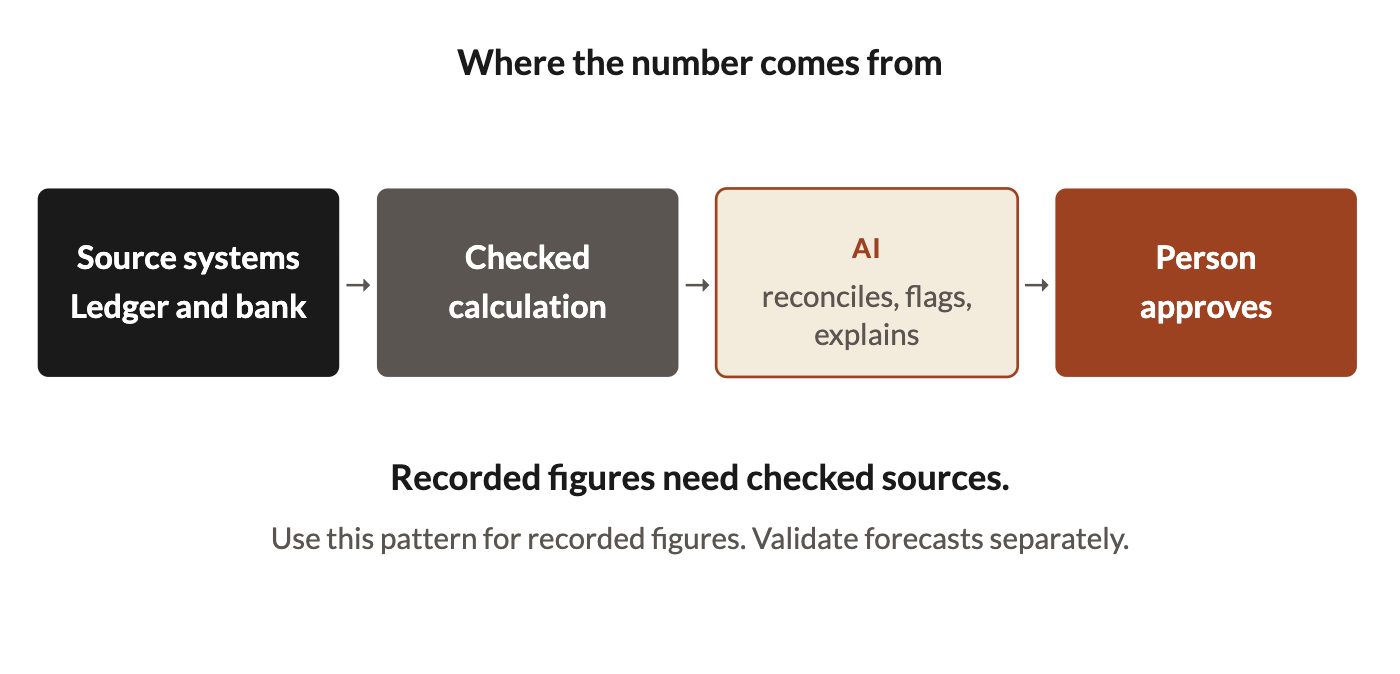 A recommended control pattern for recorded figures. Forecasts need separate validation.
Can AI make forecasts or detect anomalies?
Yes. AI can estimate future values or identify unusual transactions. An anomaly is an item that differs from an expected pattern. These outputs are estimates or signals, not ledger facts.
Validate forecasts against relevant historical cases and compare them with a baseline method. A baseline is the method that the team uses for comparison. Track forecast error, data changes, and known limits. For anomaly detection, measure missed problems and false alerts. Human review and control requirements depend on the action and its risk.
Useful support tasks also include invoice matching, variance commentary, and close checklists. For variance commentary, supply checked totals and ask the model to explain the difference. Review the explanation before external reporting.
Why can a pilot create more work?
A disconnected assistant can add copying, checking, and correction steps. Compare the whole work process before and after the pilot. Include staff review time, not just the time that the model takes to produce a draft.
Keep sensitive finance data in approved systems. Check access rights and records of system activity. Test what happens when an invoice is incomplete, a source is stale, or two records conflict.
How Chiri approaches this. Chiri's small teams of senior operators and engineers work with the customer's team. They connect software to approved systems and define permissions and review controls. The goal is fewer manual transfers and clearer source evidence. Results depend on the scope, data, and integration requirements. See Chiri's services
How can a finance team assess a pilot?
- Identify whether each output is a recorded fact, calculation, estimate, or explanation.
- Trace recorded figures to checked sources or calculations.
- Define approvals for payments and external reports.
- Test representative cases, including incorrect and missing inputs.
- Measure the full task time and error rate.
- Assign an owner for changes, exceptions, and ongoing review.
Source evidence is necessary for recorded figures, but it does not prove the whole system is safe. Check permissions, calculations, tests, and approvals as well.
Read Where AI Rollouts Go to Die for organisational risks. See Why AI Agents Break After the Demo for wider reliability checks.
Map the task and its risks before changing the model or expanding the pilot. Talk to Chiri.
Questions and answers
Can AI work with financial numbers?
Yes, with controls that match the task. Use checked sources for recorded figures. Validate forecasts and estimates separately. Review outputs before consequential actions.
What did Gartner's finance survey find?
Among the 183 respondents, 59% reported AI use. Among AI adopters, 37% used accounts payable automation and 34% used anomaly detection.
Can model quality cause a finance pilot to fail?
Yes. Model errors can contribute alongside data, integration, controls, and user adoption. Test each part before assigning a cause.
What should happen before AI affects a payment?
Check the amount against approved records. Apply the required approval rules. Record the source evidence and the action. Define how the team handles exceptions.