How to Choose a Managed AI Services Provider
Published . Updated .
Choose a managed AI services provider by comparing operating evidence, not promises alone. Ask shortlisted providers to demonstrate relevant experience, security controls, incident escalation, reporting, and an achievable exit. Use identical scenarios and request supporting documents. Then put responsibilities, service commitments, charges, and handover obligations into the contract. Treat unresolved evidence gaps as selection risks, not details to settle after signing.
What should you establish before comparing providers?
Write a one-page evaluation brief covering your systems, sensitive data, operating hours, and consequences of failure. Name an internal owner who can approve changes and accept operational risk. Record decisions your company will retain, including spending authority and permission to suspend automated actions.
Keep this separate from deciding the service package. Use our guide to managed AI services for a 200-person company for that scope discussion. Here, compare whether each candidate can operate within your requirements.
Ask every candidate to respond to the same brief. Otherwise, you may compare a narrow support proposal against a broader operating commitment.
What evidence demonstrates operational capability?
Request a walkthrough involving systems and workflows resembling yours. Ask who operates the service after implementation, who provides backup, and how staff receive handover information. Seek a redacted operating procedure, incident report, and customer reference where available.
Deloitte describes managed services to “optimize AI infrastructure and model performance.” That describes an offering, not demonstrated suitability for your environment. Ask candidates to explain how they would detect declining output quality and restore an acceptable service.
Use AI observability—understanding system behavior through operational signals—to frame reporting questions. Request a sample showing failures, output-quality checks, costs, and unresolved issues. Ask which signals your team can inspect directly.
How should you assess security and accountability?
Ask candidates to map where your data travels and who can access it. Request evidence for access approvals, access removal, activity logging, data retention, and incident notification. Ask which subcontractors participate and how their access receives oversight.
Request relevant security assessment summaries under confidentiality where necessary. Check their scope, date, exclusions, and relationship to your proposed service. Do not treat a logo or broad assurance as an answer about your deployment.
Use AI governance consulting deliverables to frame accountability questions. Ask who approves changes, records exceptions, and accepts residual risk. Require named owners on both sides, rather than assigning responsibility to “the partnership.”
What happens when something goes wrong?
Run a scenario: an automated workflow starts sending incorrect customer messages outside business hours. Ask who detects it, who can stop it, and when your company receives notice. Then ask who restores service and explains the failure.
Coeo states, “If an issue occurs, our team responds quickly and keeps you informed from start to finish.” Translate assurances like this into proposed contractual commitments. Separate acknowledgment time from restoration targets, and define incident severity and update frequency.
Ask what happens when the first contact cannot resolve the issue. Request the escalation path, backup contacts, and a sample post-incident review. Check whether your company can trigger escalation directly.
How do you compare pricing and portability?
Request a worked monthly bill using the same workload assumptions for every provider. Separate management fees, model usage, infrastructure, changes, and emergency work. Ask who approves extra spending and how the provider reports budget overruns.
Portability means your ability to move operations elsewhere. Abacus describes its approach as “Vendor-agnostic by design.” Treat such positioning as a starting point for questions, not proof of an easy transfer.
Ask who owns configurations, code, documentation, and operating records. Request export formats, transfer procedures, termination charges, and transition support terms. Ask a replacement operator what information they would need before accepting the handover.
How should you score the shortlist?
Use this suggested scorecard; it is buyer advice, not an industry standard. Mark each area as unsupported, documented, or demonstrated, and record the evidence behind your judgment.
| Evaluation area | Evidence to request |
|---|---|
| Operational capability | Relevant walkthrough, operating procedure, customer reference |
| Security | Data map, access process, assessment scope |
| Escalation | Incident scenario, contacts, service commitments |
| Transparency | Sample report, worked bill, spending approvals |
| Portability | Export example, ownership terms, transition plan |
| Accountability | Named owners, approval records, review process |
Set non-negotiable requirements before scoring, so strengths cannot conceal an unacceptable gap. Choose only after the proposal, evidence, and contract describe the same operating arrangement.
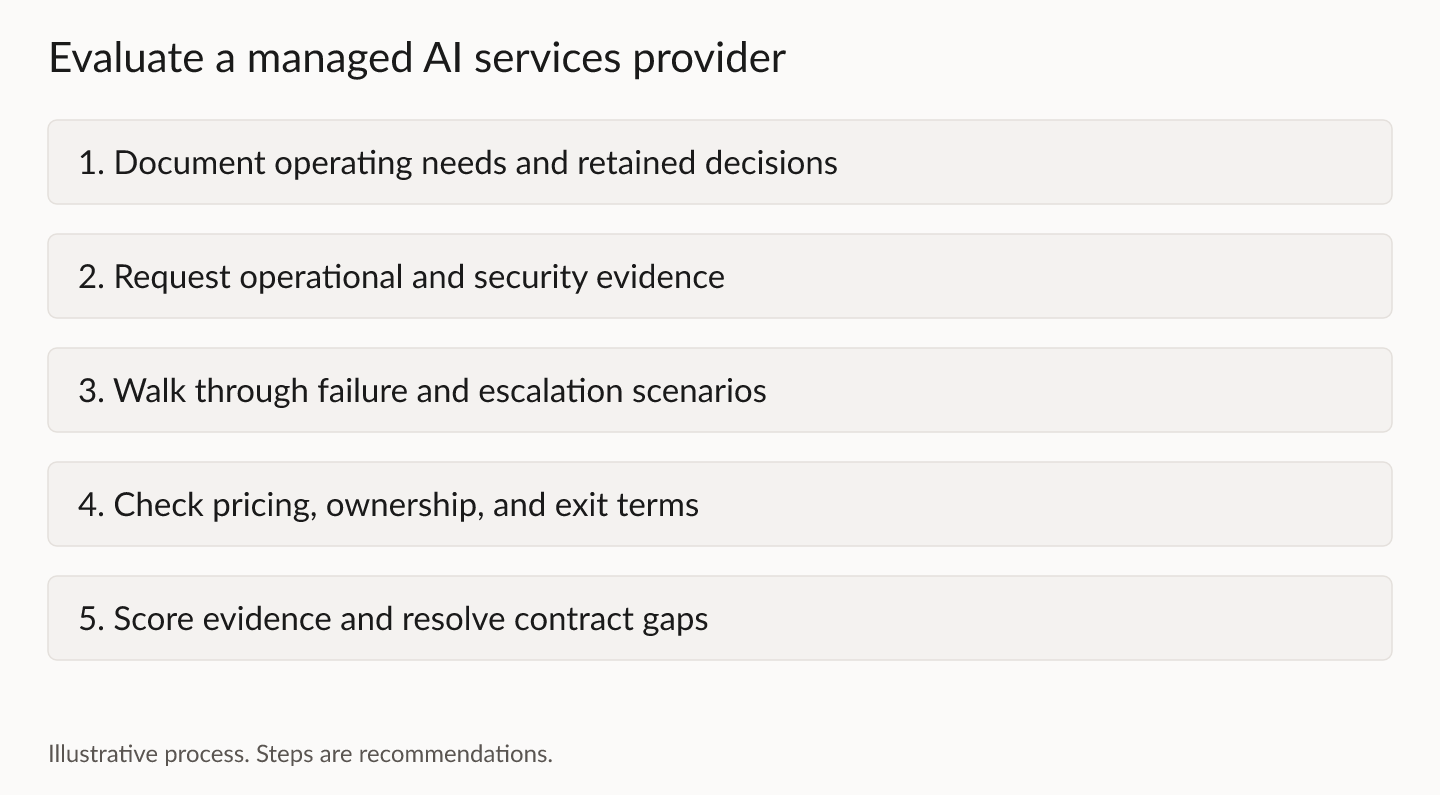
Compare evidence and contract commitments before selecting a managed AI services provider.
- Document operating needs and retained decisions
- Request operational and security evidence
- Walk through failure and escalation scenarios
- Check pricing, ownership, and exit terms
- Score evidence and resolve contract gaps