What Managed AI Services Should Cover at a 200-Person Company
Published . Updated .
Managed artificial intelligence (AI) services should cover agreed ongoing operations. Your company should retain authority over priorities, data access, acceptable risk, and spending. Ask the provider to own specific tasks, not an undefined promise to “handle AI.”
For a 200-person company, start with responsibilities rather than a proposed department structure. The framework below offers buying advice, not a universal service standard.
What separates managed services from an implementation project?
For this guide, managed AI services means continuing operation and improvement of agreed AI workflows. An implementation project introduces those workflows; a managed engagement continues after launch.
Providers describe continuing work differently. Team 400 advertises “ongoing monthly deliverables,” distinguishing its offer from one-off projects. ITECS lists “Ongoing optimization, office hours, prompt-library maintenance, governance, and Agent Operations.”
These descriptions show advertised scope, not proof of delivery. Compare written responsibilities rather than assuming every managed offer includes the same work. For broader context, read how AI changes managed service delivery.
Which responsibilities should the provider cover?
Use this proposed allocation as a starting point. Adapt it to your systems, existing support arrangements, and available decision-makers.
| Area | Ask the provider to operate | Keep company authority over |
|---|---|---|
| Access | Configure approved permissions; remove access when instructed | Which people and systems may access which data |
| Integrations: connections between applications | Maintain agreed connections; investigate failures | Source-system ownership and permitted business actions |
| Monitoring | Track failures, output quality, usage, and agreed spending alerts | Acceptable quality and spending limits |
| Support | Receive reports, diagnose problems, document fixes | Business urgency and staff communications |
| Changes | Test updates and document how to reverse them | Approval for changes affecting business risk |
| Reporting | Summarize incidents, changes, usage, and unresolved issues | Priorities, budget decisions, and expansion |
Make the boundaries concrete. If the provider monitors failures, specify which workflows, signals, and support hours that includes. If it maintains integrations, identify responsibility when another supplier changes an application.
Separate routine maintenance from new development. Ask which changes the recurring fee covers and which require a separate estimate. Include responsibility for training new users and updating operating instructions.
What should stay in-house?
Retain decisions about business purpose, data access, risk acceptance, and whether work may proceed without human approval. A provider can recommend settings; name someone internally who can authorize them.
Assign these responsibilities to people, not necessarily new job titles. One person might cover several decisions, while another supplies specialist advice. Name a backup wherever delays would interrupt an important workflow.
Define human review precisely. SageKeeper states, “Your people review every output before it moves.” Treat that as one provider’s stated approach, not a universal requirement. Decide which outputs need review, who reviews them, and what happens when nobody is available.
If you cannot identify decision owners or permitted data, start with an AI readiness assessment. Use it to identify gaps before negotiating operational coverage.
How should escalation work when something goes wrong?
For this guide, escalation means routing a problem to someone with relevant authority or expertise. Ask for a written route covering detection, containment, notification, repair, and restart approval.
Consider a hypothetical assistant sending information to the wrong destination. Specify whether the provider may pause it immediately, who receives the alert, and who approves restarting it. Ask what records the provider preserves and how staff continue working meanwhile.
Ask two separate contract questions: When will the provider acknowledge an incident, and when will it restore the workflow? Request written commitments for each, including exceptions and update arrangements. Agree support hours, backup contacts, and responsibility for problems involving another supplier.
What should you ask before signing?
Request a sample report and a walkthrough of one incident. Ask the provider to explain who notices, acts, approves, and communicates at each stage. Use the walkthrough to expose responsibility gaps before accepting the scope.
Ask what you can retrieve when the engagement ends: configuration, instructions, change history, documentation, and account access. Clarify ownership and reuse rights in writing rather than assuming payment transfers everything.
Request reporting that connects operating activity to your chosen business objective. For example, compare staff rework alongside usage rather than treating more requests as success. Agree who supplies each measure and how you will interpret it.
How should you start without committing too broadly?
Begin with one bounded workflow, named users, approved data, and explicit exclusions. Agree acceptance criteria, a fallback process, and a review point without prescribing an arbitrary rollout deadline.
Use a practical AI implementation path alongside the operating agreement. At review, assess output quality, staff effort, incident handling, spending, and documentation. Expand only when the evidence supports your criteria and both sides understand their continuing responsibilities.
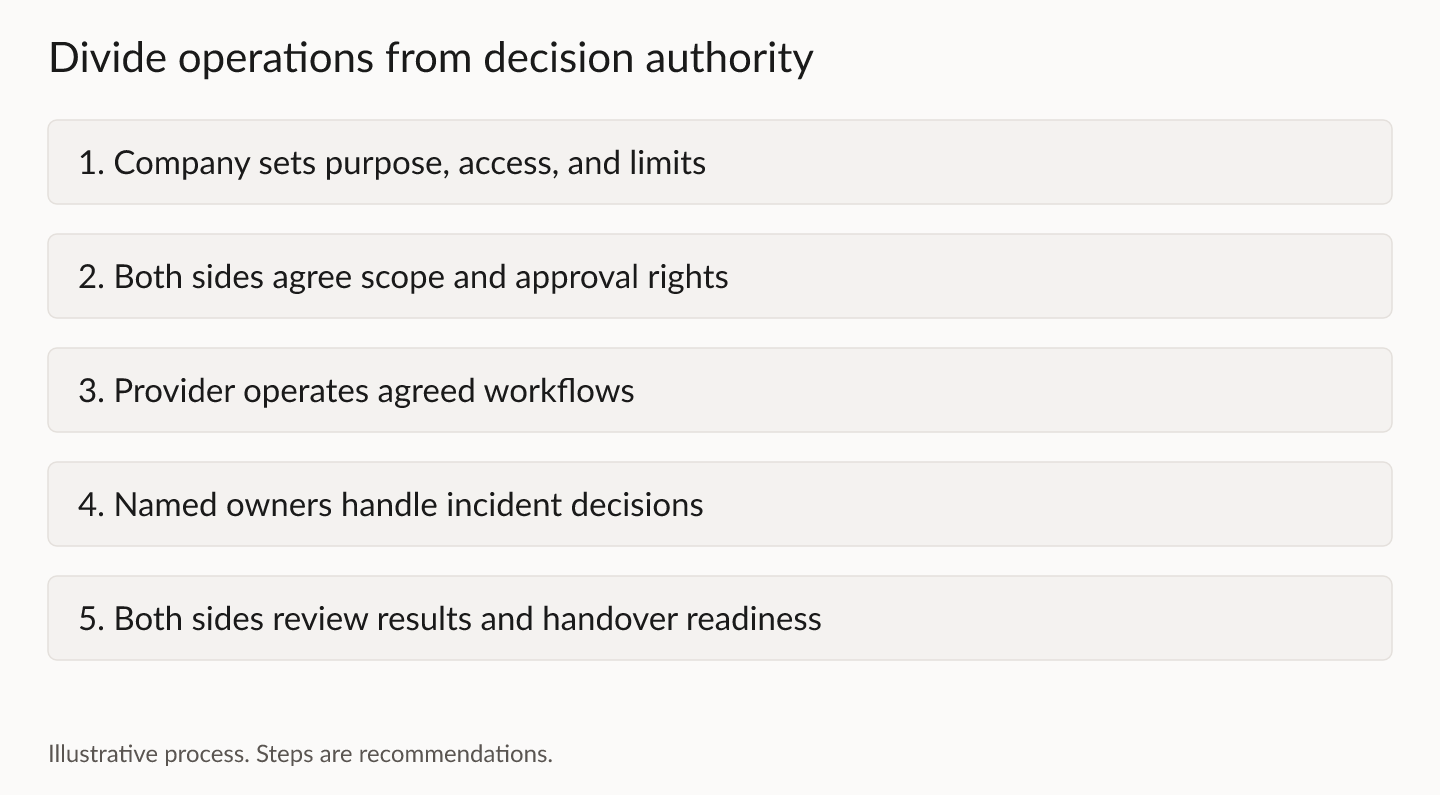
A proposed split between provider operations and company decision authority.
- Company sets purpose, access, and limits
- Both sides agree scope and approval rights
- Provider operates agreed workflows
- Named owners handle incident decisions
- Both sides review results and handover readiness