How to Implement AI in Business
Published . Updated .
AI means artificial intelligence. Implementing AI in a business means putting a specific AI system into regular use for a defined task. The system needs the right data, approved connections, review rules, and an owner. Start with one task. Expand after the first system meets agreed measures in daily use.
This guide sets out a practical sequence. It is a planning approach, not a guarantee of results. Timing and effort depend on the task, the data, and the controls the work requires.
Why do many AI projects stop before production?
In July 2024, Gartner forecast abandonment of at least 30% of generative AI projects after proof of concept by end-2025. A proof of concept tests whether an idea can work. Gartner named poor data quality, weak risk controls, rising costs, and unclear business value. This was a forecast, not a measured failure rate. Gartner forecast
S&P Global reported that more companies abandoned most AI initiatives before production. The share rose from 17% in its 2024 edition to 42% in 2025. The 2024 edition surveyed 1,001 respondents from November 14 to December 14, 2023. The 2025 edition surveyed 1,006 respondents from October 21 to November 25, 2024. Respondents reported scrapping 46% of proofs of concept on average in the later survey. The results describe those samples, not every company or industry. S&P Global research
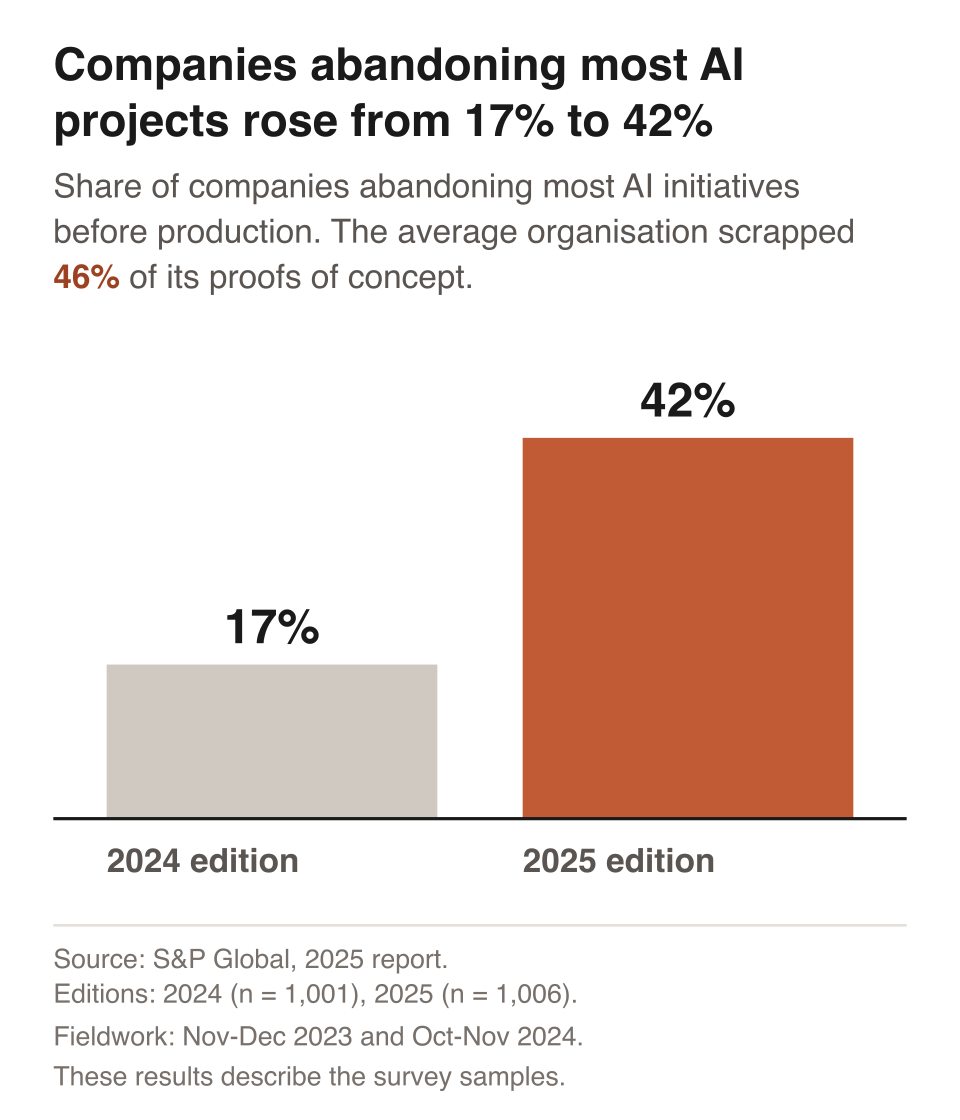 Survey edition years differ from fieldwork years. These results describe the samples, not every company or industry.
Both sources point to work around the model: data, controls, cost, and a clear business case. A step-by-step plan addresses those requirements before and during delivery.
What are the steps?
| Step | What to do | What to have before moving on |
|---|---|---|
| 1. Choose one task | Select a task with an owner, a measure, and enough volume to matter | An agreed goal, an owner, and a baseline measure |
| 2. Check readiness | Review data, definitions, systems, controls, and users | A list of gaps, each with an owner and a date |
| 3. Run a limited pilot | Test with representative inputs and a small group of users | Results compared with acceptance criteria agreed in advance |
| 4. Move to production | Connect approved systems and set permissions, monitoring, and support | A system in daily use with a named owner |
| 5. Measure and expand | Compare results with the baseline and choose the next task | A recorded decision to continue, adjust, or stop |
A baseline is the measure before the change, such as time per case or error rate. Without it, a team cannot show what the system changed.
How do you choose the first task?
A good first task usually has these features:
- It repeats often. Volume makes the effort worthwhile and produces enough cases to test.
- It has a clear measure. For example, cycle time, error rate, or cases handled per day.
- Its data is available and permitted. The team can access the sources it needs under existing policies.
- People can review the output. A reviewer can catch errors before they cause harm.
- It has an owner. One person is accountable for the result after launch.
Avoid a first task where an unreviewed error could cause serious financial, legal, or customer harm. Those tasks can come later, with stronger controls.
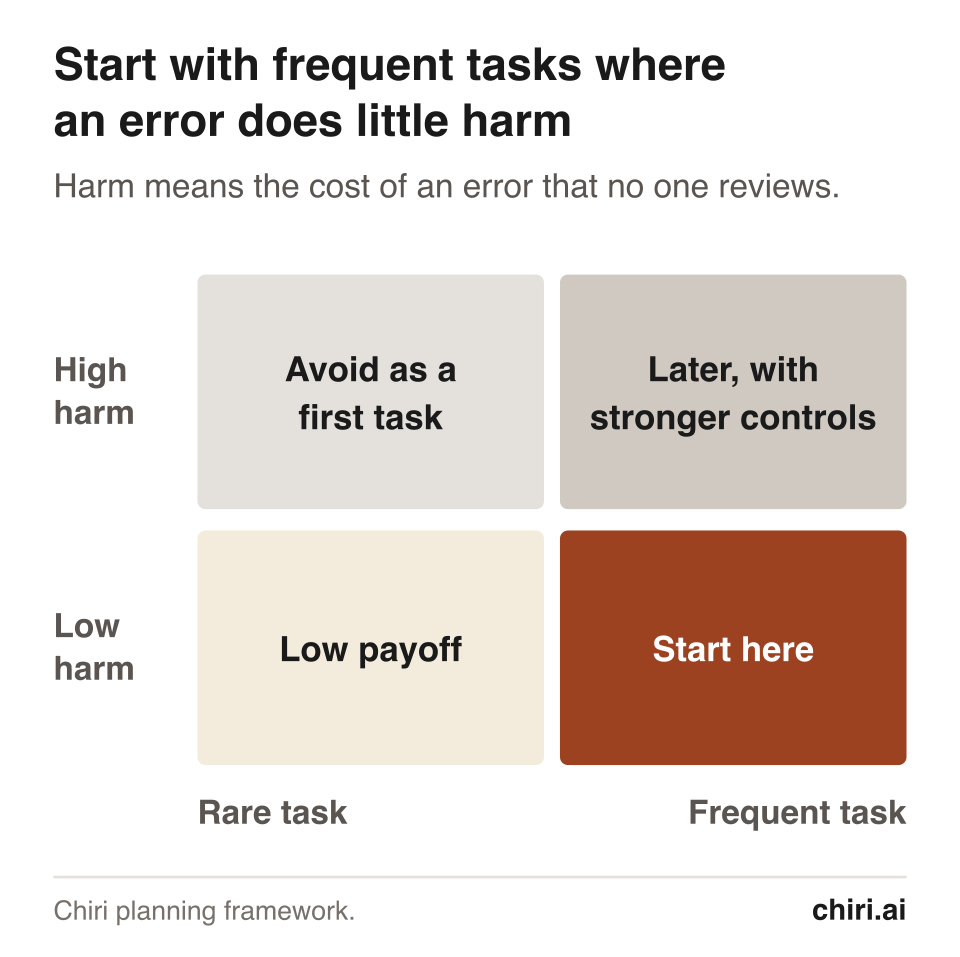 A planning aid, not a scoring model.
AI Readiness Assessment: Six Practical Checks explains the readiness check in step 2.
What should a pilot prove?
A pilot tests whether the system meets agreed criteria under realistic conditions. A demonstration shows that an idea can work. The two are different. A pilot should use representative inputs, including incomplete and difficult cases. It should record failures and the reasons for them. The people who will use the system should take part.
Agree the acceptance criteria before the pilot starts. For example, the share of cases completed without correction, or the time a reviewer needs per case. Why AI Agents Break After the Demo explains the difference between demonstration conditions and production conditions.
Before moving to production, review the pilot's evidence with the AI launch approval checklist for company leaders. It covers outcome, data permissions, quality, human review, spending limits, and the operating owner.
Who should do the work?
Companies usually choose an internal team, an outside partner, or a combination. The right choice depends on available skills, the timeline, and who will operate the system after launch. Compare the options before you commit:
- What Is a Forward Deployed Engineer? compares internal, vendor, and outside delivery teams.
- Is AI Consulting Worth It? explains how to assess an outside proposal.
- How to Choose an AI Automation Agency lists questions for automation providers.
How Chiri approaches this. Chiri is an AI managed service provider. This means Chiri builds, operates, and improves company-specific software. Small teams of senior operators and engineers work with the customer's team. Chiri targets first production systems within weeks. Timing depends on scope, access, data, and required controls. See Chiri's services
What happens after the first system?
Keep the owner, the measures, and the review rules in place. Check results against the baseline at agreed intervals. Review permissions when the system's tasks change.
A second task can reuse checked data sources, agreed definitions, approved connections, and existing controls. Reuse can reduce effort, but it does not guarantee faster delivery. Each new task still needs its own readiness check, because its data, users, and risks can differ.
Measuring the result is a step of its own. How to Measure AI ROI explains how to compare value with full cost.
Planning a first AI system, or the next one after a pilot? Talk to Chiri.
Questions and answers
How long does AI implementation take?
It depends on the task, data access, security reviews, and integration work. A narrow task with available data can move quickly. Agree milestones for the specific scope rather than a general timeline.
Should a company start with an AI strategy?
A company-wide view helps set priorities, shared infrastructure, and governance. Combine it with task-level planning. A strategy does not replace the readiness check for the first task.
What is the difference between a pilot and production?
A pilot tests a limited version against agreed criteria. Production means the system is in regular use, connected to approved systems, with monitoring, support, and a named owner.
Does a company need to hire AI engineers first?
Not always. Some companies train existing engineers, some use an outside partner, and some combine both. Decide based on skills, timeline, and who will operate the system after launch.