How to Measure AI ROI
Published . Updated .
AI means artificial intelligence. ROI means return on investment. For AI, it compares the value a system adds with its full cost over a defined period. Estimate additional benefits and additional costs against the same baseline. Express both in money over the same period. Agree the measure, the baseline, and the cost items before delivery, not after.
What does the research show?
IBM's 2025 CEO Study surveyed 2,000 chief executives. Respondents reported that 25% of their AI initiatives delivered the expected return over the previous few years. They reported that 16% scaled across the enterprise. These are executive reports, not audited results. IBM CEO Study
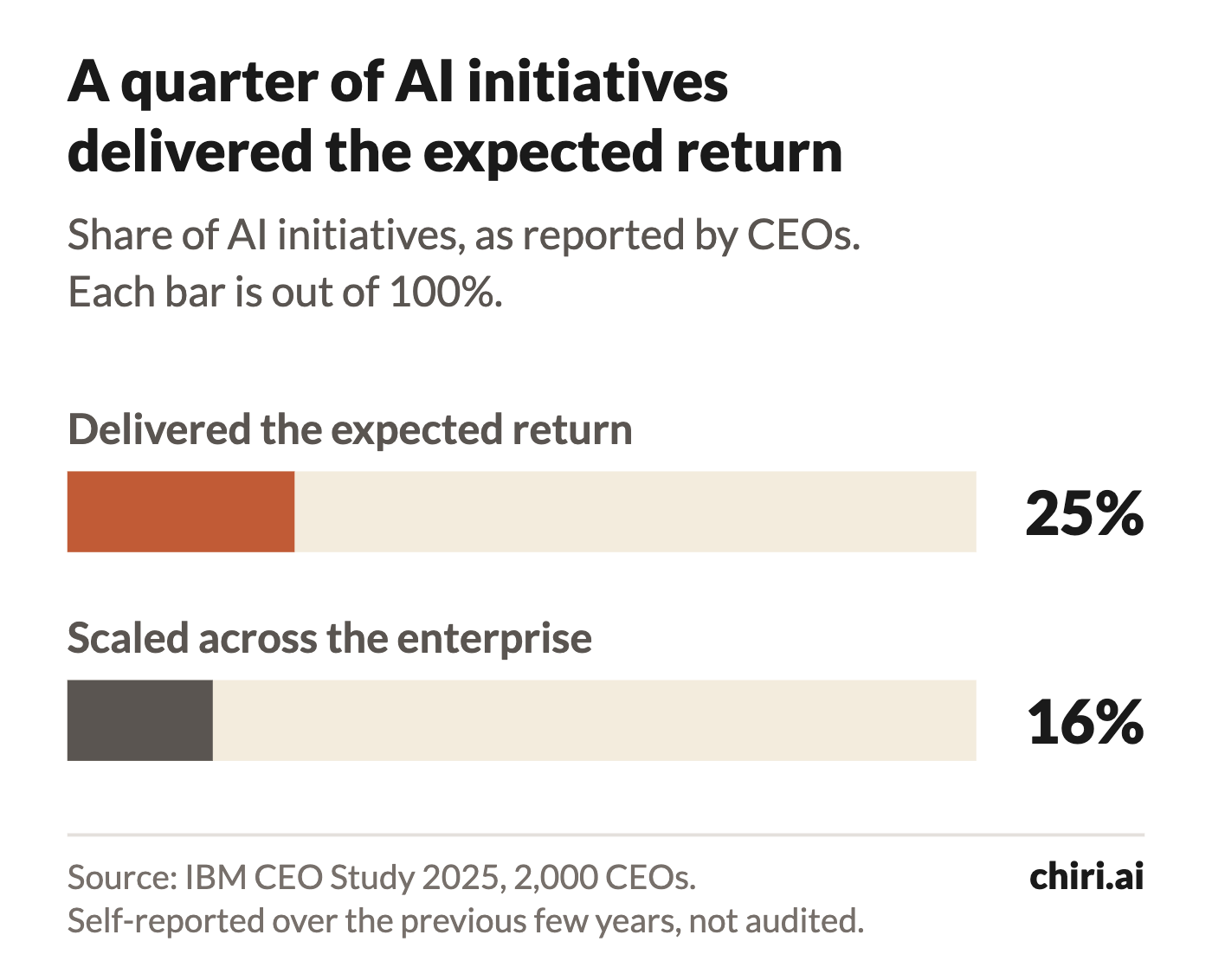 Figures describe the CEOs' own assessment of their initiatives.
In July 2024, Gartner forecast abandonment of at least 30% of generative AI projects after proof of concept by end-2025. Unclear business value was one of the reasons it named. This was a forecast, not a measured failure rate. Gartner forecast
Neither source shows how each company measured value. A defined method makes results easier to compare and defend.
How do you calculate it?
ROI (%) = ((additional benefits − additional costs) ÷ additional costs) × 100.
Additional benefits and additional costs compare the AI system with the same alternative, usually continuing the existing process. Include build costs and operating costs. Do not subtract an expense twice if you already deducted it when estimating benefits.
For example, additional benefits of 150 and additional costs of 100 produce a 50% return. Both figures use the same currency and one-year period. These figures are illustrative, not Chiri pricing or a promised result.
If additional costs are zero, this calculation does not apply. For longer periods, record when costs and benefits occur. A simple ROI percentage does not account for the time value of money.
What counts as value?
| Value | Example measure | Note |
|---|---|---|
| Time saved | Hours per case multiplied by case volume | Counts only if the time goes to other useful work |
| Errors avoided | Error rate before and after, and the cost of each error | Needs a reliable error record |
| Faster cycle time | Days from request to completion | Valuable when speed affects revenue or cost |
| Revenue contribution | Additional revenue after related delivery costs, compared with a control group | Do not count all revenue as profit |
| Reduced risk | Fewer incidents under a documented measurement method | Report uncertain benefits separately from confirmed financial returns |
A control group is a comparable group that does not use the system. It helps separate the system's effect from other changes.
What counts as cost?
| Cost | What to include |
|---|---|
| Build and setup | Internal time, outside fees, and data preparation |
| Model usage | Charges for each request, which grow with volume |
| Integration | Connections to existing systems and their maintenance |
| Review and oversight | Time people spend checking and correcting outputs |
| Maintenance | Testing after model or data changes, and support |
| Change and training | Time to train users and change the work process |
Review time is easy to miss. If people check every output, include that time in the cost. Model usage is easier to manage when measured per completed task. Chiri explains that measure in Cheaper Tokens, Bigger Bills.
How do you set a baseline?
Measure the task before the system goes live. Use the same measure you will use afterwards, over a comparable period. Record the volume, the time per case, the error rate, and the cost of doing the work today. If no records exist, collect them for a few weeks before launch.
What are the common measurement mistakes?
- No baseline. The team cannot show what changed.
- Treating saved hours as cash savings. Separate released capacity from actual spending reductions. Record how people use the capacity.
- Ignoring review time. Checking outputs is part of the cost.
- Measuring the pilot instead of production. Pilot conditions can differ from daily use.
- Watching the price per request, not per task. Retries and failed attempts add cost.
- Judging too early. Some value appears only after users adapt their work.
How Chiri approaches this. Chiri's token optimization service provides per-token visibility and cost-aware routing, so teams can forecast AI spend. Small teams of senior operators and engineers work with the customer's team. See token optimization
Want to estimate where your AI spend is heading? Try the Tokenmaxxing calculator, or talk to Chiri.
Questions and answers
How soon should an AI system show a return?
It depends on the task, volume, and setup cost. Agree a review period before launch, and measure production use rather than the pilot.
Can AI ROI be negative at first?
Yes. Setup and training costs come early, and value can build as usage grows. Review the trend over the agreed period.
What if the value is hard to put in money terms?
Record an observable measure, such as error rate or cycle time. Explain any conversion to money and its uncertainty. A clear method is easier to review than an unexplained figure.
Should model costs be measured per request?
Per completed task is more useful. Retries, long instructions, and failed attempts add cost that a per-request price hides.