Custom AI Development or Off-the-Shelf Tools?
Published . Updated .
AI means artificial intelligence. An off-the-shelf AI tool is a product that many companies buy and configure. Custom AI development builds a system for one company's tasks, data, and rules. Many companies use both. Compare task requirements, data, connected systems, and controls. Also decide who will operate the system.
This is not a one-time decision for the whole company. Make it task by task.
When does an off-the-shelf tool fit?
An off-the-shelf tool often fits when:
- The task is common across companies. Examples include drafting, meeting notes, or general research.
- The product already works with your systems. It connects to the tools your team uses without custom work.
- Its data handling meets your policies. You can confirm where data goes, how long it is kept, and who can see it.
- The vendor's controls are enough. Permissions, records, and review options match the risk of the task.
Check existing products before commissioning custom work. A product that solves the task is usually faster to deploy.
When does custom development fit?
Custom development often fits when:
- The task depends on company-specific knowledge. Your terms, rules, and exceptions decide the right answer.
- It needs several internal systems. The task needs connections or combined actions that available products do not support.
- It needs specific controls. Approval rules, activity records, or data boundaries go beyond what products offer.
- It is a source of advantage. The way you do the task is part of what makes the business different.
Custom work brings its own obligations. Someone must test, maintain, and support the system after launch.
Is there a middle option?
Yes, and it is common. A company can buy a product and connect it to internal systems through an application programming interface (API). An API lets software exchange data or request actions. A company can also build company-specific logic on a shared platform rather than from scratch.
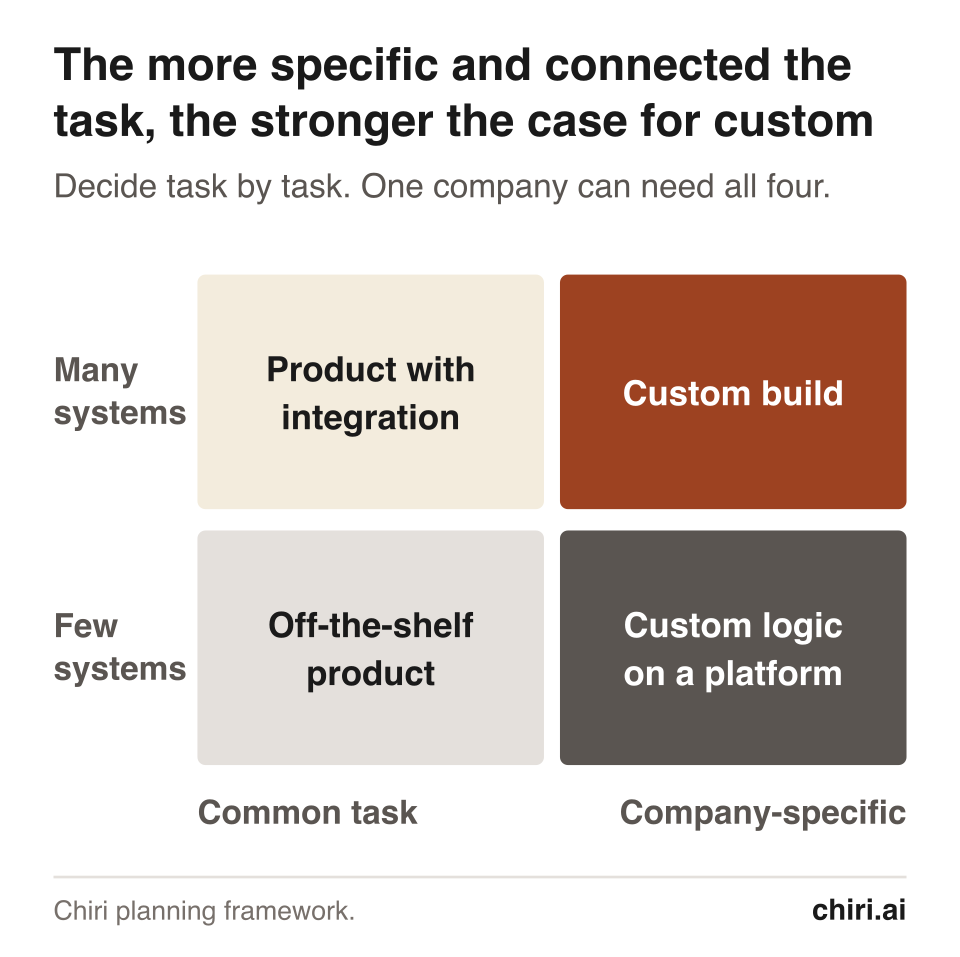 A planning aid, not a scoring model.
How should you compare total cost?
Compare the full cost over the expected life of the system, not only the purchase price or the build estimate.
| Cost | Off-the-shelf tool | Custom development |
|---|---|---|
| Licences | Per user or per use, often rising with adoption | Platform or hosting costs, if any |
| Model usage | Often included or charged by use | Charged by use; depends on model choice |
| Integration | Lower when connectors exist | Part of the build |
| Maintenance | Vendor maintains the product | You or a partner maintain the system |
| Controls and review | Limited to vendor features | Designed for the task, at extra effort |
| Switching | Depends on data export and contract terms | Depends on documentation and ownership terms |
Chiri's essay The Rented Land Problem argues that AI has narrowed the cost gap between renting software and building it. The Actual Problem Isn't AI discusses the make-or-buy question alongside vendor lock-in. Model usage costs are covered in Cheaper Tokens, Bigger Bills.
Which questions decide it?
| Question | Points to off-the-shelf | Points to custom |
|---|---|---|
| Is the task common or company-specific? | Common across companies | Depends on your terms, rules, and exceptions |
| How many internal systems does it touch? | One, with an existing connector | Several, without existing connectors |
| What controls does it need? | Vendor features are enough | Specific approvals, records, or data boundaries |
| Who will operate it after launch? | Your team and the vendor, with agreed roles | Your team or a partner with an agreed role |
| How costly is switching later? | Data export and contract allow a clean exit | Documentation and ownership terms are clear |
If most answers point one way, start there. If they split, consider the middle option: a product connected to your systems, or custom logic on a shared platform.
How Chiri approaches this. Chiri is an AI managed service provider. This means Chiri builds, operates, and improves company-specific software. Small teams of senior operators and engineers work with the customer's team. Chiri Brain provides the shared platform underneath, including integrations, governance, and activity logging. The customer and Chiri agree ownership, hosting, and operating responsibilities. See Chiri's services
Weighing a product against a custom build for a specific task? Talk to Chiri.
Questions and answers
Is custom AI development always more expensive?
Not always. Compare full cost over the system's expected life, including licences, model usage, integration, maintenance, and switching. A product can cost more over time when per-user fees grow with adoption.
Can a company start with a product and build later?
Yes. Check data export, contract terms, and how much configuration you would need to rebuild. Those decide how costly a later switch would be.
Who owns a custom AI system?
The contract decides. Agree ownership of code, configurations, prompts, test sets, and documentation before work starts, along with access and support after launch.
Should every AI task use the same approach?
No. Decide task by task. A company can use products for common tasks and custom systems where its own knowledge and controls matter.