How to Evaluate AI Control Plane Platforms for Digital Workers
Published . Updated .
Evaluate an AI control plane against one worker’s complete lifecycle: definition, identity, permissions, supervision, and retirement. Ask vendors to demonstrate each transition using your workflow, including denied actions and shutdown. Compare deployment options and operating responsibilities only after establishing these requirements. Select through a bounded pilot with written acceptance criteria, rather than a feature list or an impressive demonstration.
Here, a digital worker means an AI-enabled system assigned a bounded business job. An AI control plane means the management layer for governing those workers and their actions. These working definitions frame the evaluation; they do not establish any vendor’s capabilities.
What job will each worker perform?
Start with a worker specification, not a platform shortlist. Record its owner, business purpose, permitted tools, allowed data, expected outputs, and completion conditions. Include explicit exclusions: which decisions must it never make?
For example, an invoice worker might extract fields and prepare a payment proposal, without releasing funds. Define what happens when an invoice lacks evidence, exceeds a threshold, or conflicts with another record. Ask vendors to show how they represent those boundaries and record changes to them.
Keep this specification throughout procurement. Use it to connect each requested feature to a business requirement and a later acceptance test.
How will identities and permissions work?
Ask whether each worker receives a distinct identity: an account or identifier that separates its actions from others. Identify who owns that identity, who grants access, and who can revoke it.
AgentOpsGuide frames one control-plane problem as “knowing which agents exist and who owns them.” That editorial framing supports an inventory question, not proof that any listed product solves it.
Request a demonstration across the actual systems your worker will use. Test an allowed action, a denied action, and access removal during an active task. Ask how permissions change when the worker’s owner, role, or tools change.
Here, a harness means surrounding software intended to constrain an agent’s access and actions. Consult Chiri’s harness page alongside your evaluation, while requesting evidence for each shortlisted platform.
Who supervises actions and handles incidents?
Separate observing an action from authorizing it. Vendor Contro1’s comparison states: “Observability explains behavior; it is not the authority that approves a live business action.” Treat that distinction as an evaluation prompt, not independent product validation.
Specify which actions require human approval, who can approve them, and when approvals expire. Ask what happens when nobody responds, the approver loses access, or the proposed action changes after approval.
Request an audit record showing the worker identity, requested action, applicable policy, approval decision, and outcome. Then rehearse an incident: pause execution, investigate the record, and decide whether work can resume. Connect these requirements to practical AI governance.
For ongoing monitoring, define the signals your operators need and who responds to them. Use AI observability as a companion topic, not a substitute for action controls.
Does the platform fit your operating environment?
AIMultiple’s comparison uses three headings: “Architecture and deployment,” “Governance, identity, and security,” and “Operations and product maturity.” Use those headings to organize questions, rather than adopting its comparison scores.
Ask where the platform runs, which integrations need custom work, and who maintains each component. Request an export demonstration covering worker definitions, policies, and records. Identify what another system could reuse and what your team would need to rebuild.
For broader selection questions, consult the enterprise platform evaluation guide. Keep this evaluation focused on worker-specific requirements rather than repeating its Palantir replacement scope.
Can you suspend, replace, and retire a worker?
Write separate procedures for temporary suspension, replacement, and permanent retirement. Ask vendors to demonstrate each procedure, including its limitations.
During suspension, what happens to queued tasks, active sessions, and downstream work? During replacement, how do ownership, permissions, and unfinished tasks transfer? During retirement, who removes credentials, stops scheduled work, and confirms that execution has ended?
Specify which records you need to retrieve and how long you intend to retain them. Ask vendors to explain deletion and retention behavior separately. Do not assume that disabling a worker also removes its access or preserves its history.
What should the pilot prove?
Choose one workflow, limited permissions, and a named operating owner. Set acceptance criteria before the demonstration: task quality, approval behavior, denied-action handling, record completeness, operating effort, and retirement.
Record every result as passed, failed, or not demonstrated. Require evidence for each pass and assign an owner to every unresolved limitation. Prefer the platform that meets your essential controls under realistic conditions—not the one with the longest feature list.
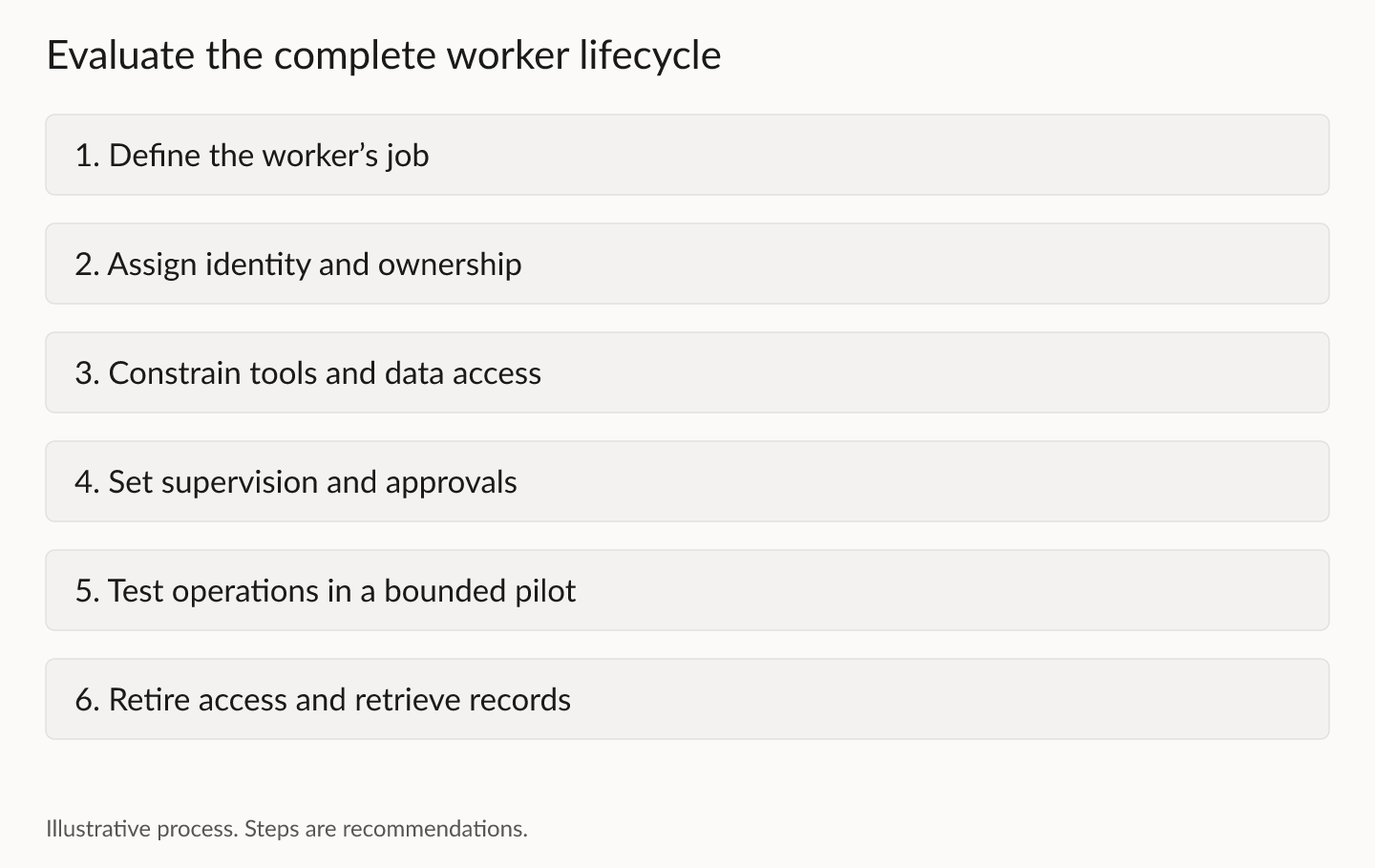
Evaluate each worker from job definition through retirement and record retrieval.
- Define the worker’s job
- Assign identity and ownership
- Constrain tools and data access
- Set supervision and approvals
- Test operations in a bounded pilot
- Retire access and retrieve records