Palantir Alternative: How to Evaluate Enterprise AI Platforms
Published . Updated .
What should buyers evaluate first?
Evaluate a Palantir alternative against specific workflows, not a generic feature list. Compare integration, governance, deployment, workflow execution, portability, and total ownership costs. Then require a proof of concept with agreed success criteria before choosing an artificial intelligence (AI) platform.
This framework offers procurement advice, not a vendor ranking or a Palantir product review. Use it to request comparable evidence from every candidate, including your incumbent.
Start with the business result: resolving an investigation, planning inventory, or approving an operational action. Name the users, required data, decision owner, and consequences of failure. Separate essential requirements from preferences before requesting demonstrations.
Which capabilities do you actually need to replace?
Write one requirement sheet for each priority workflow. Record its inputs, outputs, business rules, connected systems, approval steps, and current baseline. Identify whether you need data integration, analysis, AI assistance, operational actions, or several capabilities together.
Do not assume every candidate replaces the same scope. Vendor-published Stardog commentary cautions: “Treating them as interchangeable would produce a misleading comparison.” Treat that warning as framing, not independent evidence of any product’s capabilities.
Ask each supplier to mark every requirement as native, configured, custom-built, partner-provided, or unavailable. Require supporting documentation and identify who maintains each component. Use these answers to distinguish a demonstration from a proposed operating model.
For broader discovery, use Chiri’s AI tooling map. Treat the landscape as a starting point, not a shortlist or ranking.
How should you compare integration, governance, and deployment?
For integration, request evidence covering your actual source systems and update requirements. Ask how the platform handles changed records, deleted records, failed connections, and conflicting definitions. Include recovery procedures and responsibility for connector maintenance.
Use this working definition of governance: rules, controls, and accountability for data and AI use. Ask vendors to demonstrate permissions, approval controls, audit records, and access removal using your proposed workflow. Include a test where an unauthorized user requests restricted information.
For deployment, document acceptable hosting locations, network boundaries, and operational responsibilities. Request a data-flow diagram showing where information travels and which organizations process it. Ask about retention, deletion, backup handling, and contractual restrictions on data use.
For workflows, test the complete action, not just the generated answer. Require human approval where your policy demands it. Ask what happens after a timeout, duplicate request, incorrect answer, or failed downstream action.
If architecture terms obscure the discussion, consult our knowledge graph, vector database, and ontology comparison. Bring the discussion back to your required relationships, retrieval tasks, and business rules.
What will ownership and switching require?
Define portability as your ability to move necessary assets into another environment. Separate raw data exports from business definitions, permissions, application logic, prompts, and evaluation records. Ask suppliers to demonstrate exports rather than merely promise them.
Stardog’s commentary states: “Data portability is not the same as semantic or workflow portability.” Here, semantic portability means preserving business meanings when moving between systems. Test whether another team can interpret exported assets without relying on the original supplier.
Build a three-year ownership estimate using your own workload assumptions. Include licensing, infrastructure, model usage, integration, implementation, training, support, and ongoing maintenance. Treat estimates as scenarios, not guaranteed costs.
Entrans-published guidance advises: “Look beyond initial licensing fees.” Request comparable commercial proposals before drawing price conclusions. Assign an internal owner for every recurring task.
If considering Chiri’s platform, request current documentation and apply the same evidence requirements. Do not assume capabilities from a platform label or delivery-model description.
What should a proof of concept prove?
Use this working definition of a proof of concept: a bounded trial against explicit requirements. Select representative workflows, including difficult cases, and use appropriately authorized data. Agree on pass conditions before suppliers begin implementation.
Use a compact evidence worksheet:
- Requirement: business outcome, owner, priority, and current baseline.
- Test: input, expected result, failure case, and acceptance threshold.
- Evidence: observed result, supporting record, unresolved issue, and accountable owner.
Measure task completion, answer quality, permission enforcement, recovery behavior, and operating effort where relevant. Choose thresholds appropriate to your workflow rather than borrowing unsupported industry benchmarks.
How do you turn evidence into a shortlist?
Set mandatory requirements before assigning weighted scores. Reject candidates that fail essential security, deployment, or workflow requirements. Then weight remaining criteria according to business importance.
Keep unsupported claims marked as unknown, not as confirmed capabilities. Record delivery dependencies, contract conditions, and unresolved risks beside each score. Choose the platform that meets your documented requirements with acceptable ownership and exit obligations—not the longest feature list.
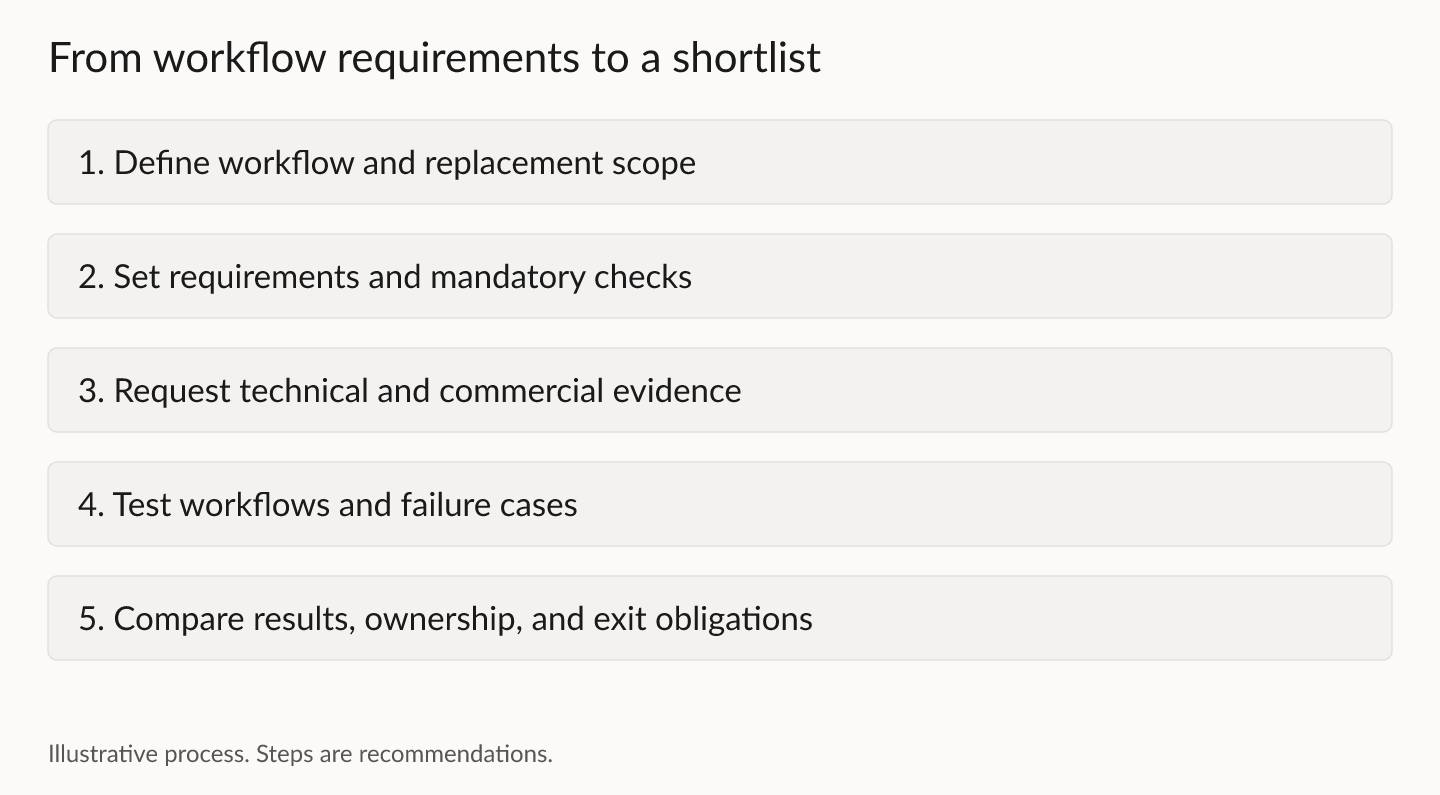
Move from workflow requirements to evidence, testing, and a defensible shortlist.
- Define workflow and replacement scope
- Set requirements and mandatory checks
- Request technical and commercial evidence
- Test workflows and failure cases
- Compare results, ownership, and exit obligations