How to Detect Shadow AI Without Turning Discovery Into Surveillance
Published . Updated .
Find unauthorized artificial intelligence (AI) use by comparing approved tools, purchasing records, employee feedback, and narrowly scoped technical signals. Set collection limits first, validate findings with teams, and reserve restrictions for specific risks. Treat discovery as an inventory exercise, not an employee performance investigation.
The following shadow AI detection workflow offers practical buyer advice, not a proven formula or jurisdiction-specific legal guidance.
What should discovery establish?
Start with a written question: which AI services handle company work outside an explicit approval boundary? Palo Alto Networks defines shadow AI around use without technology or security teams’ approval, monitoring, or involvement. Its definition includes “artificial intelligence tools, systems, or AI agents.” For background, see Chiri’s shadow AI overview.
Define approval by service, account type, permitted data, and intended task. Avoid treating a familiar brand as approval for every use. Record whether your team approved a use, rejected it, or has not reviewed it. Set a discovery window and assign someone to resolve uncertain cases.
Create a tool-and-use inventory with owners and next actions. Do not make employee activity scores part of that output.
Which signals should you collect first?
Begin with information you already hold: approved-tool inventories, purchase records, expense categories, and existing software integration lists. Ask teams which tasks need AI support and which approved options leave gaps. Request service names and business purposes, not copied conversations.
Add technical signals only for a defined unanswered question. Consider managed-device software records, browser extension inventories, or existing network logs. Prophet Security’s detection guide lists browser management reports among signals for installed AI extensions and applications. It also cautions that network logs only reveal traffic passing through their collection points.
Keep each signal’s limits visible. Do not present one network view as a complete inventory or proof of unauthorized work. Record which devices, accounts, and time periods each source covers before interpreting a finding.
What should discovery leave out?
Write a collection notice before expanding monitoring. Specify the purpose, fields, access permissions, retention period, and escalation conditions. Ask privacy and legal specialists to assess the proposed scope where appropriate. Do not assume this workflow satisfies local requirements.
As a starting boundary, exclude AI conversation contents, screenshots, keystrokes, and unrelated personal activity. Prefer service-level or team-level records until you need an accountable owner. Require a documented reason before requesting more identifying information or content.
Strac’s vendor guidance similarly recommends detection without reading prompts or logging keystrokes. Treat that guidance as advice, not evidence that a particular product meets your collection limits. Ask vendors to demonstrate collection settings, access restrictions, and deletion controls before buying.
How do you validate a finding without accusing someone?
Label an initial finding “possible AI use,” not “policy violation.” Ask the relevant team to confirm the service, business task, account arrangement, and data category. Explain which signal prompted the question and what information you did not collect.
Consider a hypothetical example: a service appears in a network log. Ask whether it supported company work and whether an existing approval covers that activity. Do not send an automatic disciplinary referral. Keep unanswered questions visible rather than replacing them with assumptions.
Record the evidence, the team’s explanation, the applicable approval rule, and the unresolved uncertainty. Separate confirmed unauthorized use from activity that needs review because the rules remain unclear.
When should you restrict use?
Prioritize confirmed findings by data sensitivity, permissions, business dependence, and available safeguards. Do not treat every unfamiliar tool as equally urgent. If evidence indicates active sensitive-data exposure, use your incident process rather than waiting for routine inventory review.
For lower-risk cases, consider a time-limited review with explicit boundaries. For higher-risk cases, consider restricting the affected integration, account, or data flow. Document the reason, owner, review date, and permitted alternative. Consult Chiri’s broader AI security guidance alongside your assessment of safeguards beyond discovery.
What should happen after discovery?
Give each confirmed finding an outcome: approve within limits, offer an alternative, pause pending assessment, or prohibit the use. Explain how employees can request review or challenge an incorrect classification. Update the inventory and connect decisions to your AI acceptable-use policy.
Schedule a review that matches your organization’s pace of change. Track unresolved tools, review turnaround, and available alternatives—not individual usage leaderboards. Aim for a defensible approval boundary that supports useful work, not permanent observation of every employee interaction.
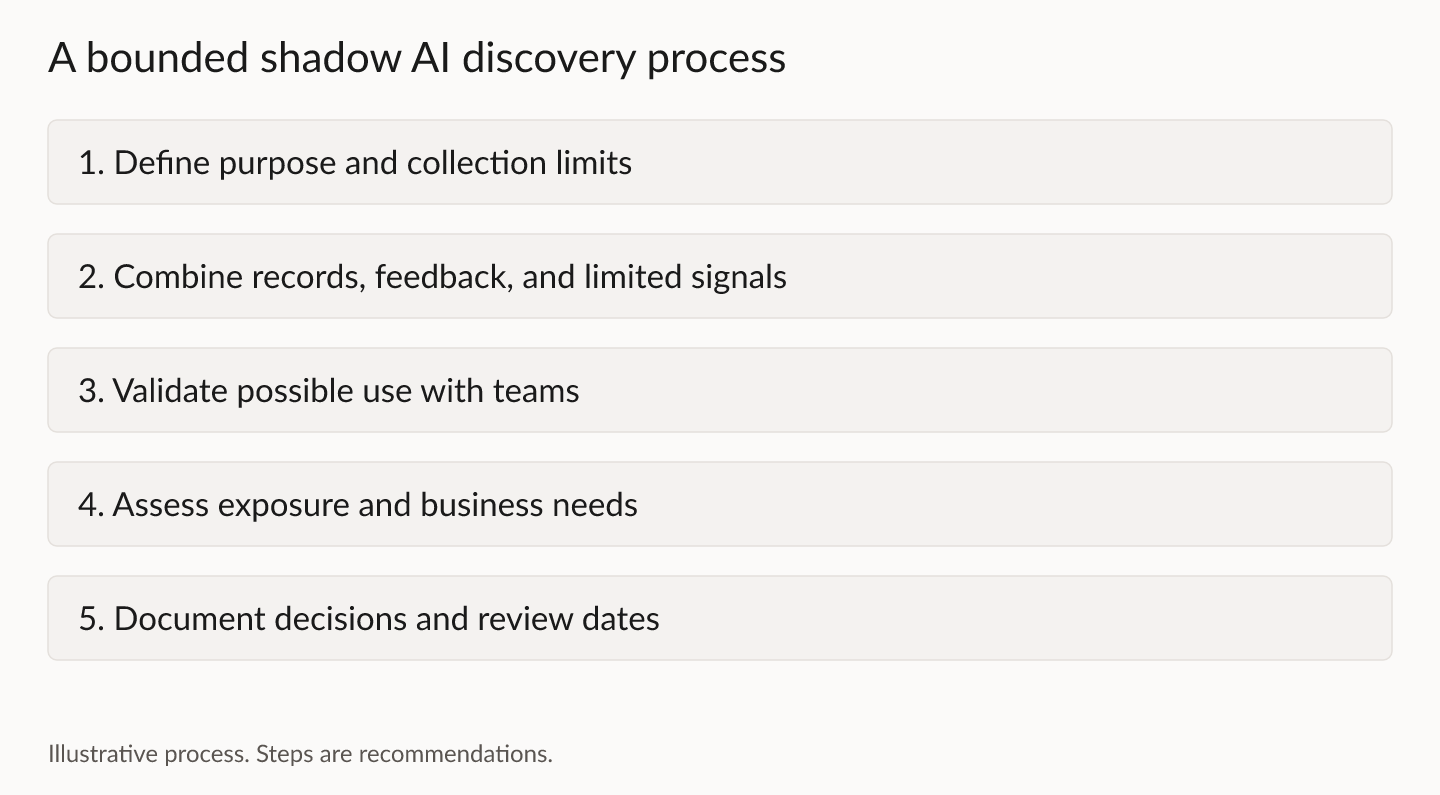
Set collection limits, validate possible use, and choose a proportionate response.
- Define purpose and collection limits
- Combine records, feedback, and limited signals
- Validate possible use with teams
- Assess exposure and business needs
- Document decisions and review dates