What Are Agentic Workflows?
Published . Updated .
AI means artificial intelligence. An agentic workflow is a business process in which an AI agent decides some of the steps, while fixed rules handle the rest and people approve the risky ones. An AI agent is software that uses a model and tools to choose its next action toward a goal. The design question is not whether to use an agent, but which steps need one.
Anthropic, which builds the Claude models, draws the line between the two building blocks this way:
"Workflows are systems where LLMs and tools are orchestrated through predefined code paths. Agents, on the other hand, are systems where LLMs dynamically direct their own processes and tool usage, maintaining control over how they accomplish tasks."
Anthropic, Building effective agents, December 2024
An LLM, or large language model, is the type of model behind tools such as ChatGPT and Claude. Most useful business systems combine both blocks: predefined paths where the steps are known, and agent decisions where they are not.
How is an agentic workflow different from automation?
| Fixed automation | Agentic workflow | Fully autonomous agent | |
|---|---|---|---|
| Who decides the next step | Rules written in advance | Rules for most steps, an agent for the steps that need judgement | The agent, for every step |
| Predictability | High | High on fixed steps, lower on agent steps | Lower |
| Best for | Repeated tasks with known inputs | Processes with a few judgement calls inside a known structure | Open-ended research or exploration |
| Example | Copy invoice fields into the accounting system | Match an invoice to an order, ask the agent to explain any mismatch, send mismatches over a set amount for approval | Research a supplier from scratch and recommend one |
Chiri's primer Your Next Hire Might Not Be Human explains what agents are. What Is AI Orchestration? covers the layer that coordinates agents, rules, data and people once the workflow is designed.
How widely are agentic systems expected to spread?
In June 2025, Gartner forecast that 33% of enterprise software applications will include agentic AI by 2028, up from less than 1% in 2024. It also forecast that at least 15% of day-to-day work decisions will be made autonomously through agentic AI by 2028, up from 0% in 2024. These are forecasts, not measurements. Gartner forecast
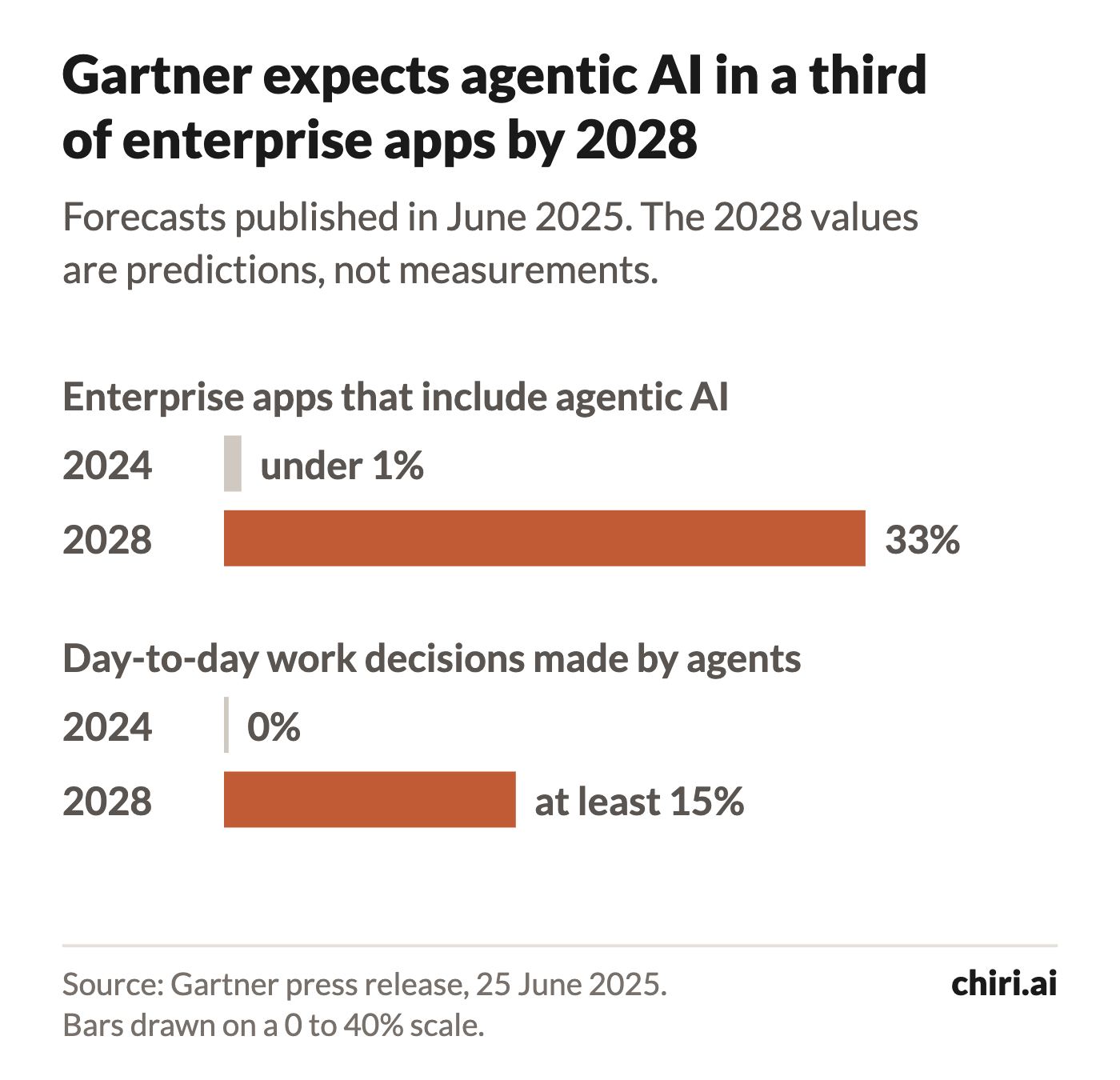 Forecasts published in June 2025, not measured adoption.
The same release forecast that over 40% of agentic AI projects will be cancelled by the end of 2027, citing escalating costs, unclear business value or inadequate risk controls. Gartner also estimated that only about 130 of the thousands of vendors claiming agentic AI offer it, describing the rebranding of existing products as "agent washing". In a January 2025 Gartner poll of 3,412 webinar attendees, 19% said their organisation had made significant investments in agentic AI and 42% conservative ones. A poll of webinar attendees is not a representative sample.
Survey data on current use is more cautious than the forecasts. In McKinsey's 2025 State of AI survey of 1,993 participants, 23% said their organisations are scaling an agentic AI system somewhere in the enterprise, and another 39% had begun experimenting. No more than 10% reported scaling agents in any single business function. McKinsey, November 2025
"They can start by using AI agents when decisions are needed, automation for routine workflows and assistants for simple retrieval."
Anushree Verma, Senior Director Analyst, Gartner, June 2025
How do you design an agentic workflow?
Start from the process, not the model. Map each step, then decide who or what should handle it.
- Map the current process. List every step, its inputs, its output and who does it today.
- Classify each step. Is it a fixed rule, a judgement call, or a decision that needs a person's approval?
- Give the agent only the judgement steps. Keep calculations, lookups and routine transfers as fixed rules.
- Set limits. Decide what the agent can read and change, and which actions wait for approval.
- Test and trace. Test on real past cases and record each step, so the team can see where a run went wrong.
| Step type | Handled by | Example in an invoice process |
|---|---|---|
| Fixed rule | Automation | Read the invoice and pull the order number |
| Lookup | Automation | Fetch the matching purchase order |
| Judgement | Agent | Explain why the totals differ and suggest a cause |
| Approval | Person | Approve payment when the difference exceeds the agreed limit |
| Record | Automation | Log the decision, the evidence and the approver |
Why AI Agents Break After the Demo explains why testing on real cases matters. Chiri's launch approval checklist covers the evidence to review before the workflow goes into routine use.
When should a company not use an agent?
When every step is predictable, fixed automation is cheaper, faster and easier to check. Anthropic gives the same advice: "We recommend finding the simplest solution possible, and only increasing complexity when needed. This might mean not building agentic systems at all." (Anthropic)
Add an agent where the work needs judgement that rules cannot express, such as reading an unusual document or explaining a mismatch.
How Chiri approaches this. Chiri is an AI managed service provider. This means Chiri builds, operates, and improves company-specific software. Small teams of senior operators and engineers work with the customer's team. Chiri Brain provides orchestration, an agent runtime, integrations, organizational memory, governance, and security underneath each workflow. See Chiri's services
Mapping a process to decide where an agent belongs? Talk to Chiri.
Questions and answers
What is an agentic workflow in simple terms?
A business process where an AI agent handles the steps that need judgement, fixed rules handle the predictable steps, and people approve the risky ones.
Is an agentic workflow the same as an AI agent?
No. An agent is one component. The workflow is the whole process, including fixed steps, approvals and records around the agent.
Is an agentic workflow the same as AI orchestration?
They are related. The workflow is the design of the process. Orchestration is the layer that runs it, routing each step to the right model, tool, data source or person.
Do agentic workflows replace automation tools?
Usually not. Most agentic workflows still rely on fixed automation for routine steps and use an agent only where judgement is needed.
How many companies use agentic workflows today?
Published figures are mostly forecasts and polls. Gartner forecast in June 2025 that 33% of enterprise software applications will include agentic AI by 2028, up from less than 1% in 2024.