What Is AI Orchestration?
Published . Updated .
AI means artificial intelligence. AI orchestration coordinates an AI system's steps, tools, and controls. It decides which model, tool, data source, or person handles each step. It passes information between steps and records what happened.
A single question to a chat assistant needs little orchestration. A business task with several steps, systems, and approvals needs much more.
What does AI orchestration coordinate?
| Part | Role in the task |
|---|---|
| Models | Produce text, classifications, or decisions for individual steps |
| Tools and connected systems | Read records or take actions in software the company already uses |
| Data sources | Supply the information each step needs, within access rules |
| People | Review, approve, or correct steps that need human judgement |
| Rules and permissions | Limit what each step can read or change |
| Activity records | Record inputs, actions, and outputs so the team can review them |
An AI model produces outputs from inputs. Different models can generate content, classify records, or estimate values. A tool is a function the system can call, such as searching a database or creating a ticket.
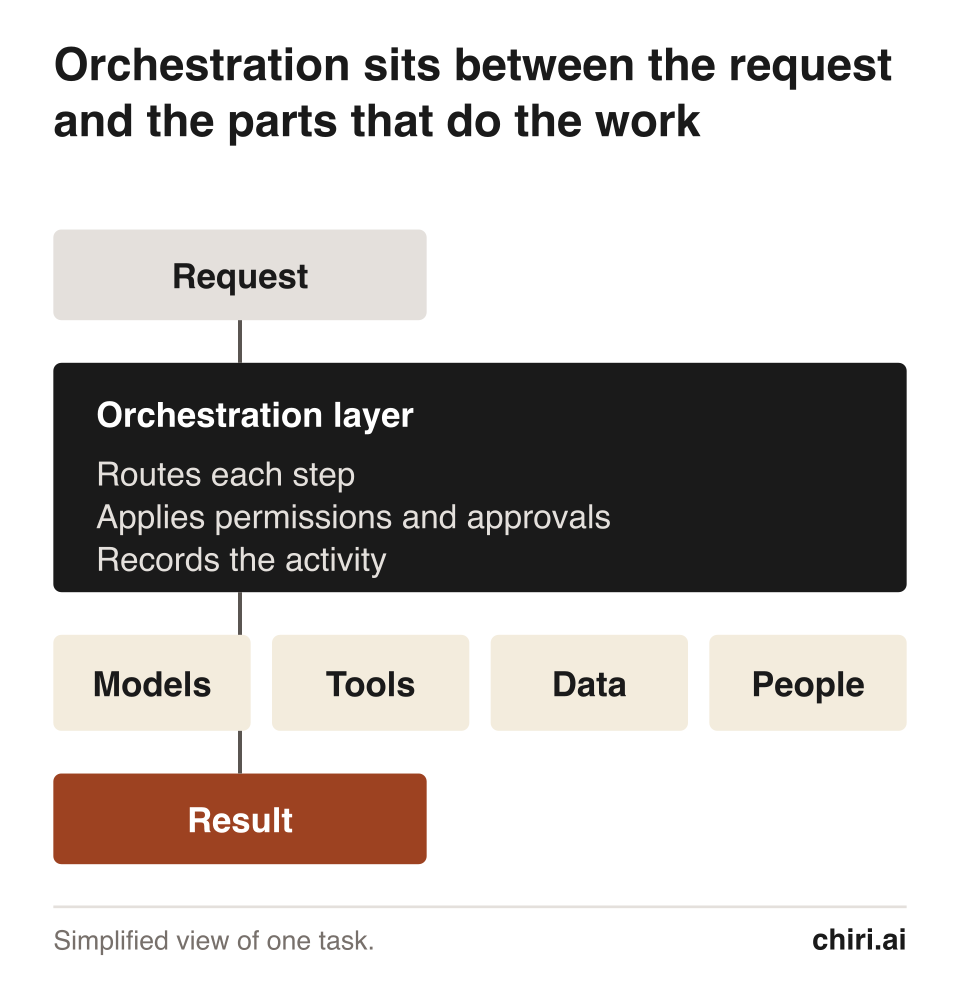 Real systems can repeat or skip steps. This shows one pass.
How is orchestration different from automation and agents?
The terms overlap, and vendors use them differently. This table describes common usage.
| Term | What it usually means | Example |
|---|---|---|
| Workflow automation | Fixed steps that follow set rules | When an invoice arrives, copy its fields into the accounting system |
| AI agent | A system that uses a model and tools to choose steps toward a goal | Investigate a customer query and draft a response with order details |
| AI orchestration | Coordination of models, agents, tools, data, and people across a process | Route the query, check the order system, apply approval rules, and record each step |
Orchestration can include fixed automation and agents. It is the layer that keeps them working together under the same rules.
Why does orchestration matter for multi-step work?
Each extra step adds another chance of error. Orchestration can add checks between steps, retries, alternative routes, and human approval before risky actions. Why AI Agents Break After the Demo shows how reliability can fall as steps add up.
In June 2025, Gartner forecast cancellation of over 40% of agentic AI projects by the end of 2027. It named escalating costs, unclear business value, and inadequate risk controls. Agentic AI refers to systems that plan and take actions toward a goal. This is a forecast, not a measured cancellation rate. Gartner forecast
Cost and risk controls are both orchestration questions. Which model handles each step affects cost. Which steps need approval affects risk.
What should a company check in an orchestration layer?
- Model choice. Can each step use a suitable model, and can the team change models later without rebuilding the task?
- Permissions. Can the team limit what each step reads and changes?
- Approvals. Can risky actions wait for a person before they run?
- Activity records. Can the team see inputs, actions, and outputs for each step, with appropriate data protection?
- Failure handling. What happens when a step fails or returns an unexpected result?
- Cost visibility. Can the team see the cost of each completed task, not only total model spend?
The Model Agnosticism Principles discusses changing models. What an AI Harness Does explains controls around agents.
How Chiri approaches this. Chiri Brain is a managed AI agent platform. It provides orchestration, an agent runtime, integrations, organizational memory, governance, and security. Chiri's small teams of senior operators and engineers build company-specific applications on that foundation. See Chiri Brain
Mapping a multi-step task across several systems? Talk to Chiri, or see how Chiri routes work across models in token optimization.
Questions and answers
Is AI orchestration the same as an agent framework?
Not exactly. An agent framework is software for building agents. Orchestration coordinates agents with models, tools, data, people, and rules across a whole process. Some products offer both.
Does a small company need AI orchestration?
It depends on the task. A single-step task in one tool needs little. A task that crosses several systems, needs approvals, or acts on customer or financial records needs coordination and records.
Can orchestration reduce AI costs?
It can help. Routing each step to a suitable model and stopping failed tasks early can reduce wasted model usage. Results depend on the task and the models available.
Who should own the orchestration layer?
Agree this before delivery. Ownership covers configurations, permissions, activity records, and the ability to move to another provider.