AI for Accounts Payable Automation: Where Agents Fit and Where Controls Stay
Published . Updated .
AI for accounts payable automation can assist with invoice capture, coding, matching, and exception routing. Stampli describes “automating capture, coding, routing,” but that description does not establish reliability. Accounts payable covers money a company owes suppliers. Our recommendation: let agents prepare work and investigate discrepancies, while authorized people retain approval authority and payment release. Start narrowly, preserve source records, and define escalation rules before connecting agents to payment systems.
Which accounts payable steps can AI automate?
Here, an AI agent means software using an artificial intelligence model and connected tools to perform assigned tasks. Assess each task separately rather than granting authority over the entire invoice-to-payment process.
Start with intake: collect invoices, classify documents, and extract supplier names, invoice numbers, amounts, and due dates. Treat these as candidate tasks to evaluate against your own documents, not guaranteed capabilities across every invoice format.
Next, consider coding suggestions: proposed accounting categories or cost centres. Require reviewers to inspect unfamiliar suppliers, ambiguous descriptions, and unusual allocations before accepting suggestions.
For matching, compare invoices with the available purchasing and delivery records. Automation Anywhere’s marketplace listing describes validation against purchase orders and receipts, duplicate flags, and exception routing. These remain seller descriptions, not independent evidence of reliability. Ask vendors to demonstrate comparisons using your records and agreed rules.
For broader context, see our AI agent examples by business function. Here, the useful boundary is task authority, not the number of tasks automated.
How should agents handle invoice exceptions?
For this workflow, an exception means an invoice that cannot proceed under agreed processing rules. Pilot examples include missing purchase orders, quantity differences, price discrepancies, and possible duplicates.
Genpact describes exception processing and says its agents “route to humans when needed.” For your implementation, define exactly when that handoff occurs. Ask the agent to show conflicting fields, relevant records, a proposed next step, and the assigned reviewer.
For example, route a price mismatch to the designated purchasing owner with both prices visible. Route missing delivery evidence to the receiving owner; never let an agent invent delivery confirmation. These illustrate proposed routing rules, not demonstrated product capabilities.
Do not treat an explanation as permission to override a discrepancy. Give unresolved exceptions an owner and deadline, and exclude them from payment batches until resolution.
Which controls should remain with people?
We recommend retaining approval authority and payment release with authorized people, particularly during initial deployment. This is buyer advice, not a claim that every organization faces identical legal requirements.
Separate invoice preparation, approval, supplier bank-detail changes, and payment release through permissions. Do not let an invoice-processing agent approve its own work or change payment destinations.
Tipalti states, “Your team sets the rules and keeps final say on approvals.” It also says customers decide which steps need review. Ask vendors to demonstrate these boundaries rather than relying on marketing language.
Define approval thresholds, authorized substitutes, and escalation paths before launch. Our guide to human-in-the-loop AI explains controls where people approve proposed actions before execution.
What should integrations and audit trails preserve?
Designate the accounting system as the authoritative record for approved invoices and payment status. Specify which systems the agent may read, which fields it may update, and which actions require approval.
Preserve original invoices alongside extracted fields and later corrections. Link purchasing records, delivery evidence, coding suggestions, exceptions, approvals, and payment references through stable identifiers.
For this design, an audit trail means a record of actions and decisions over time. Require timestamps, actor identities, evidence references, approval decisions, and the rules applied to each action.
Define what happens when a connection between systems fails. Pause uncertain updates and check existing status before retrying. Require retries to check for existing invoices or payment instructions before creating new ones.
Use our AI controls guide when planning permissions, evidence, and accountability.
What should an accounts payable pilot measure?
Use this checklist as a proposed evaluation method, not an industry benchmark. Choose representative invoices and document the existing workflow before enabling automated actions.
- Accuracy: Compare extracted fields and coding suggestions with reviewer-approved answers. Report errors by field and invoice type.
- Processing time: Measure invoice receipt to readiness for approval, including waiting and human review. Use the same definition for the comparison workflow.
- Exceptions: Track unresolved cases, their age, responsible owners, and whether proposed resolutions matched reviewer decisions.
- Controls: Test duplicate submissions, changed bank details, missing delivery evidence, unauthorized approvals, and unavailable connections before expanding permissions.
- Review: Record overrides and corrections, then agree expansion criteria with finance owners. Consult our finance pilot risks guide.
Start with preparation and routing. Expand only when the pilot meets agreed measures and preserves intended approval boundaries.
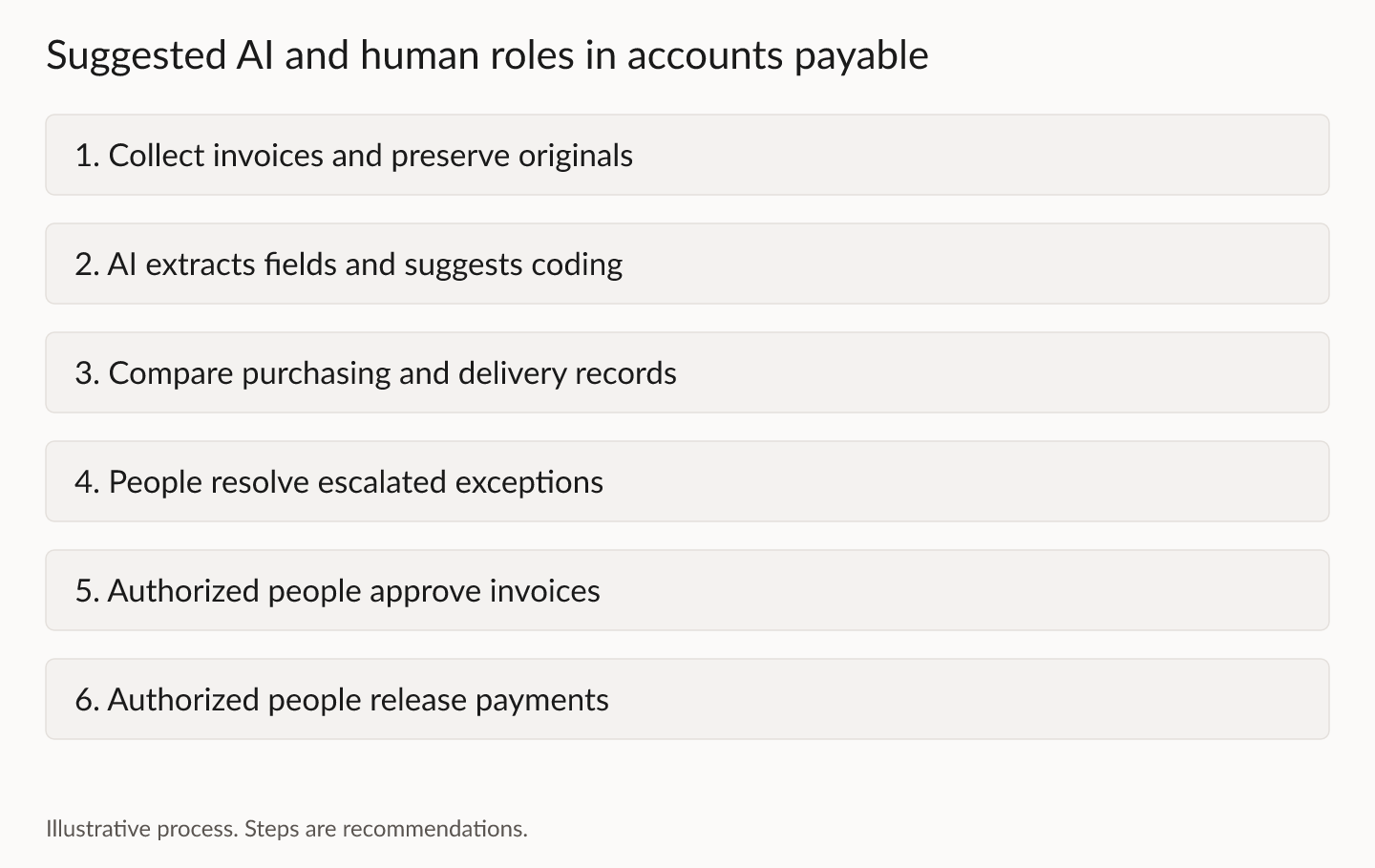
Suggested boundaries between AI-assisted invoice work, human review, and payment release.
- Collect invoices and preserve originals
- AI extracts fields and suggests coding
- Compare purchasing and delivery records
- People resolve escalated exceptions
- Authorized people approve invoices
- Authorized people release payments