AI Agent Examples by Business Function
Published . Updated .
AI means artificial intelligence. An AI agent is software that uses a model and tools to pursue a goal and take actions, not just answer questions. Google Cloud puts it this way:
"AI agents are software systems that use AI to pursue goals and complete tasks on behalf of users. They show reasoning, planning, and memory and have a level of autonomy to make decisions, learn, and adapt."
Google Cloud, What are AI agents?
In the 361-profile Chiri Atlas dataset used for the Tooling Map, 81 profiles describe agent products in their tags, focus or name. The examples below come from those profiles, grouped by the business function they serve.
How widely do companies use AI agents?
McKinsey's 2025 State of AI survey of 1,993 participants found that 23% of respondents' organisations are scaling an agentic AI system somewhere in the enterprise, and an additional 39% have begun experimenting. In any single business function, no more than 10% reported scaling agents. Agent use was most commonly reported in IT and knowledge management. McKinsey, November 2025
A PwC survey of 308 US executives in April 2025 found that 79% say AI agents are already being adopted in their companies. More than half were using or planning to use agents within six months in customer service (57%), sales and marketing (54%) and IT and cybersecurity (53%). Those function figures combine current use with plans. PwC, May 2025
Where do the agent products in Chiri Atlas sit?
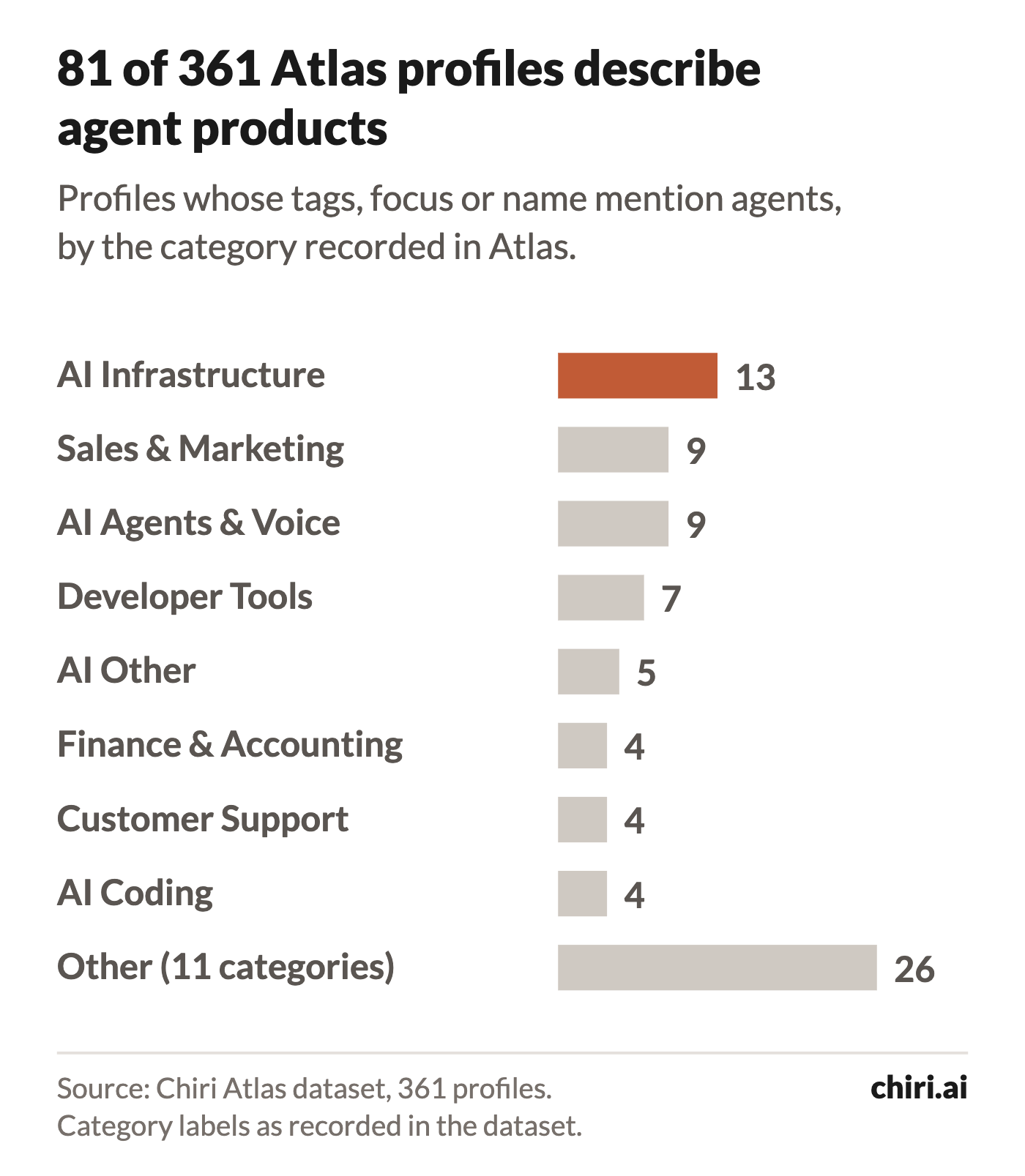 Category labels as recorded in Atlas. One profile can serve several functions.
The largest group is AI Infrastructure: platforms for building and running agents rather than finished agents for one department. A company that buys one of these still has to design, connect and govern the agent itself. Function-specific agents spread across sales, support, finance, HR, engineering and security.
What are real examples of AI agents by function?
Each example links to its Chiri Atlas profile. The descriptions summarise what the profile records, not a test of the product.
| Function | Example | What the Atlas profile describes |
|---|---|---|
| Sales | 11x.ai | Sales development agents for outbound outreach and inbound lead qualification |
| Sales | Regie.ai | Agents for outbound prospecting and parallel dialing |
| Customer support | Decagon | Customer support automation across channels, including voice |
| Customer support | Retell AI | Voice agents for call centre automation |
| Finance | Basis | Accounting agents for reconciliation and categorisation, working with QuickBooks and Xero |
| Finance | Pigment | Agents inside a financial planning and analysis platform |
| HR | Tezi | An autonomous recruiting agent with applicant tracking |
| HR | GoodTime | Agents for interview scheduling |
| IT and engineering | Resolve AI | Agentic incident response and production engineering |
| Security | Dropzone AI | Alert triage agents for security operations |
| Procurement | Zip | Procurement orchestration from intake to payment |
| Procurement | Pactum AI | Agents for contract negotiation |
For HR in more depth, see AI in HR: What the Tools Actually Do. The full dataset is described in The AI Tooling Map.
How do you tell a real agent from a relabelled chatbot?
Not every product called an agent can act on its own. In June 2025, Gartner described "agent washing", the rebranding of existing chatbots and automation tools without substantial agentic capabilities, and estimated that only about 130 of the thousands of agentic AI vendors are real. Gartner, June 2025
Ask to see the agent complete a real task in your systems. Check what it can change on its own, what needs approval, and whether every action is recorded. How to Choose a Generative AI Development Company lists questions for vendors.
How do you pick a first agent use case?
Start with one frequent task where the agent's output is easy to check, such as triaging support tickets or reconciling transactions. Design which steps the agent decides and which stay fixed rules, as described in What Are Agentic Workflows?. Then run a readiness check: AI Readiness Assessment.
Three signs make a task a good first candidate:
- It repeats often. Volume gives enough cases to test the agent and to measure the result.
- A person can check the output quickly. A reviewer should be able to accept or correct the agent's work in seconds or minutes.
- Mistakes are cheap to reverse. Start where an error costs a correction, not a customer or a payment.
Keep tasks that move money, change customer records or affect decisions about people for later, once the team has controls and traces in place.
Method and limits
A profile counts as an agent product when its tags, industry focus or name contains "agent", "agents", "agentic" or "autonomous agent". Category labels come directly from the dataset. The dataset is the 361-profile Chiri Atlas file used for the Tooling Map; profile dates vary. Mentioning agents is a self-description, not proof of autonomous capability. scripts/verify-ai-agent-examples.py recomputes the counts.
How Chiri approaches this. Chiri is an AI managed service provider. This means Chiri builds, operates, and improves company-specific software. Small teams of senior operators and engineers work with the customer's team. Chiri targets first production systems within weeks. Timing depends on scope, access, data, and required controls. See Chiri's services
Looking for the right first agent for your team? Talk to Chiri, or browse Chiri Atlas.
Questions and answers
What is an example of an AI agent?
A support agent that resolves customer requests across chat and voice, such as Decagon, or an accounting agent that reconciles and categorises transactions, such as Basis. Both are profiled in Chiri Atlas.
Which business functions use AI agents most?
McKinsey's 2025 survey found agent use most commonly reported in IT and knowledge management. In PwC's 2025 survey, customer service, sales and marketing, and IT and cybersecurity led planned and current use.
How many companies use AI agents?
In McKinsey's 2025 survey, 23% of respondents said their organisations are scaling an agentic AI system somewhere, and another 39% were experimenting.
What is the difference between an AI agent and a chatbot?
A chatbot answers questions. An agent pursues a goal and takes actions in other systems, such as updating records or sending messages, within the permissions it is given.
How should a company choose its first AI agent?
Pick one frequent task with output that is easy to check, decide which steps the agent handles and which stay fixed rules, and run a readiness check before building.