AI in HR: What the Tools Actually Do
Published . Updated .
AI means artificial intelligence. HR means human resources. AI in HR covers software that helps with hiring, assessment, payroll, performance, learning and onboarding. Most of it today supports hiring: of the 49 HR & Recruiting profiles in Chiri Atlas, 29 focus on recruiting or on assessing candidates. Hiring is also where the legal rules are strictest, because the tools influence decisions about people.
How widely do HR teams use AI?
SHRM, the US professional body for HR, surveyed 2,040 HR professionals in February 2025. It reported that "AI adoption in HR tasks climbed to 43% in 2025, up from the 26% reported by HR professionals in 2024." Of those using AI, 51% used it for recruitment tasks such as resume screening and candidate communication. The sample is US-only and unweighted. SHRM 2025 Talent Trends, SHRM press release
Gartner surveys of 197 HR leaders found that the share of organisations piloting or implementing generative AI rose from 19% in June 2023 to 61% in January 2025. Gartner also predicts that 50% of current HR tasks will be automated or managed by AI agents by 2030. The second figure is a forecast. Gartner, November 2025
"From the increasing integration of AI in HR functions to the persistent challenges posed by skill gaps, the findings underscore the need for businesses to prioritize upskilling and adaptability."
Alex Alonso, Chief Data & Analytics Officer, SHRM, July 2025
What do HR AI tools actually do?
The Chiri Atlas dataset used for the Tooling Map holds 361 company profiles. Its largest category is HR & Recruiting, with 49 profiles. Sorted by primary focus, they look like this:
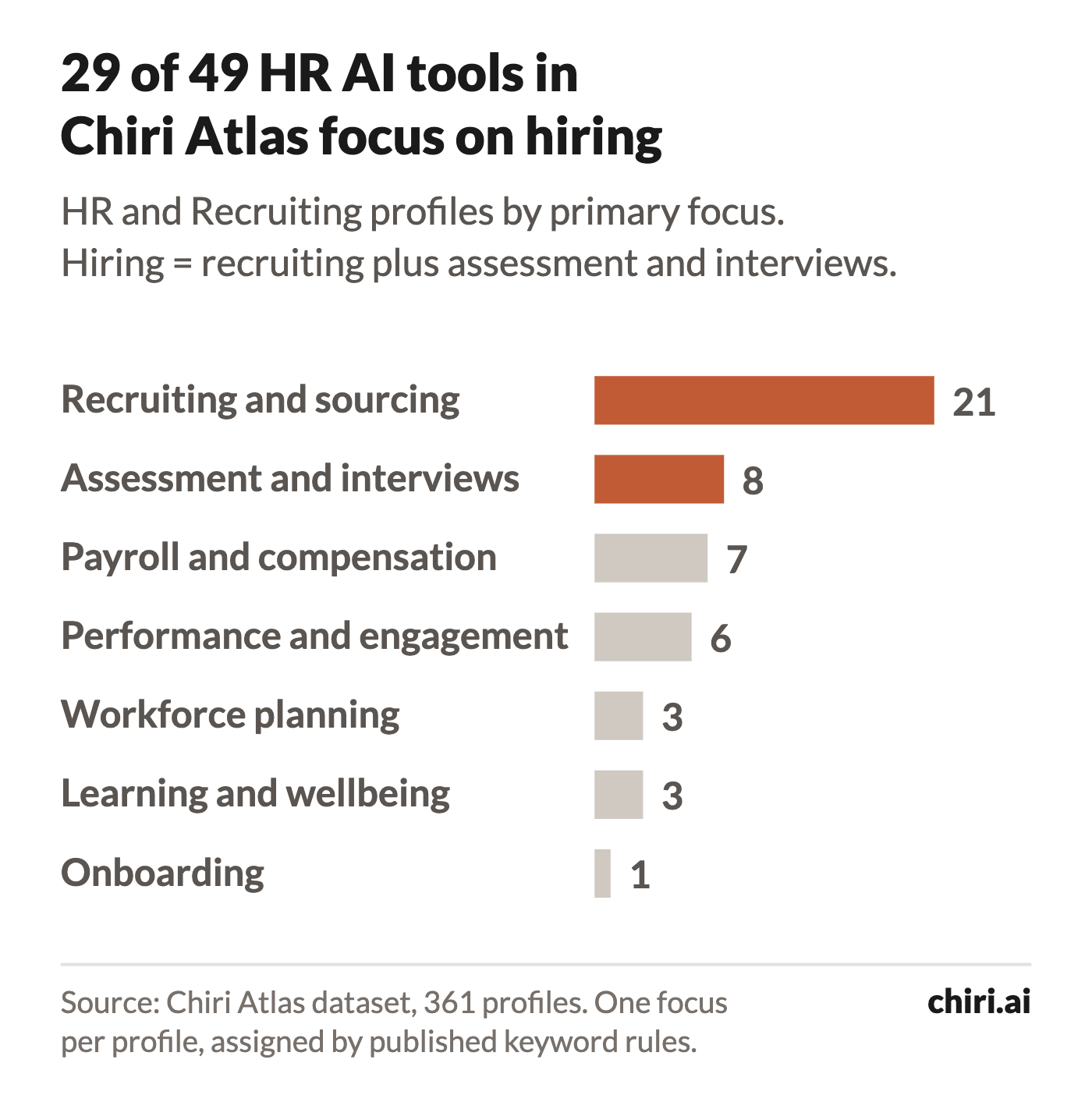 One focus per profile. The rules are listed under Method and limits.
| Focus | Profiles | What the Atlas profiles describe | Examples in Atlas |
|---|---|---|---|
| Recruiting and sourcing | 21 | Applicant tracking, candidate sourcing, interview scheduling, high-volume hiring | Greenhouse, Paradox, Tezi |
| Assessment and interviews | 8 | Skills tests, structured interviews, background checks | BrightHire, CodeSignal, Checkr |
| Payroll and compensation | 7 | Global payroll, compensation benchmarking, payroll assistants | Deel, Compa |
| Performance and engagement | 6 | Engagement analysis, performance reviews, employee relations | Culture Amp Actions AI, Lattice ER Coach |
| Workforce planning | 3 | Internal mobility, skills and workforce planning | Gloat, Beamery |
| Learning and wellbeing | 3 | Training paths, wellbeing coaching | Nivati Coach AI |
| Onboarding | 1 | Employee onboarding and offboarding | Talmundo AI |
The pattern matches the surveys: hiring is where most HR AI products, and most HR AI use, sits today. The Atlas counts describe supply, not how well any tool works. The AI Tooling Map covers the whole Atlas dataset.
Why does hiring AI need extra care?
Hiring decisions affect people's livelihoods, and regulators treat them that way.
- EU AI Act. Annex III lists "AI systems intended to be used for the recruitment or selection of natural persons, in particular to place targeted job advertisements, to analyse and filter job applications, and to evaluate candidates" among high-risk systems, with narrow exceptions. Regulation (EU) 2024/1689 A 2026 amending regulation sets 2 December 2027 as the date the main high-risk obligations apply to these systems. Regulation (EU) 2026/1744
- New York City Local Law 144. Employers may not use an automated employment decision tool unless it has had a bias audit within the past year, the audit information is public, and candidates or employees have been notified. NYC Department of Consumer and Worker Protection
This is general information, not legal advice. Check the rules that apply where you hire.
What should HR ask before buying an AI tool?
| Question | Why it matters |
|---|---|
| Which decisions does the tool influence, and who makes the final call? | A person should review decisions about candidates and employees |
| Has the tool had a bias audit, and will the vendor share it? | Required in some places, and a basic test of fairness everywhere |
| Which data does it use, and where is it stored? | Candidate and employee data is sensitive personal data |
| Can it explain a recommendation? | Recruiters need to justify decisions to candidates and regulators |
| Does it connect to the existing HR and applicant tracking systems? | Without integration, staff copy data by hand and the time saving disappears |
| What happens to the company's data if the contract ends? | Exit terms decide whether the history stays with you |
For a structured check before any AI project, see AI Readiness Assessment. If staff are already using unapproved tools with candidate data, see What Is Shadow AI?.
Method and limits
The counts come from the Chiri Atlas dataset of 361 company profiles, the same file used for the Tooling Map. The 49 profiles are those with the category "HR & Recruiting". Each was given one primary focus: the first of these rules whose keywords appear in its tags or industry focus, checked in this order: payroll and compensation; workforce planning and mobility; assessment and interviews; learning and wellbeing; onboarding; performance, engagement and relations; recruiting and sourcing. Some tools span several areas, so a different rule order would move a few profiles. scripts/verify-ai-in-hr.py recomputes every count in this article from the dataset.
How Chiri approaches this. Chiri builds, operates, and improves company-specific software as an AI managed service provider. Small teams of senior operators and engineers work with the customer. Chiri supports permissions, activity records, and shared context through its platform. See Chiri's services
Choosing where AI belongs in your people processes? Talk to Chiri, or browse HR tools in Chiri Atlas.
Questions and answers
How is AI used in HR?
Mostly in hiring today: sourcing candidates, screening applications, scheduling and structuring interviews. It is also used in payroll, performance, learning and onboarding.
How many HR teams use AI?
In SHRM's February 2025 survey of 2,040 US HR professionals, AI adoption in HR tasks was 43%, up from 26% in 2024.
Is AI in hiring regulated?
In some places, yes. The EU AI Act classifies recruitment and selection AI as high-risk, with narrow exceptions, and New York City requires bias audits for automated employment decision tools.
Will AI replace HR teams?
Gartner predicts that 50% of current HR tasks will be automated or managed by AI agents by 2030. That is a forecast about tasks, not roles. Decisions about people still need human review.
What should HR check before buying an AI tool?
Who makes the final decision, whether the tool has a bias audit, how it handles personal data, whether it can explain its output, and how it connects to existing HR systems.