How to Choose a Generative AI Development Company
Published . Updated .
AI means artificial intelligence. Generative AI creates text, images, code, or other content from instructions. A generative AI development company builds software that uses this capability for a client. Examples include an internal assistant, document drafting, or search across company knowledge.
Before you compare firms, decide two things: what you need delivered, and who will operate the system after launch. Then compare firms on testing, data handling, controls, ownership, and support.
What kinds of firms offer this work?
| Type of firm | What it usually delivers | Who operates it after launch | Check carefully |
|---|---|---|---|
| Software development firm | A custom application built to a specification | Your team, unless you buy a support contract | Handover documentation and who fixes issues |
| Product vendor with services | Its own product, configured for you | The vendor | How much fits your task without custom work |
| Consultancy | Advice, a plan, and sometimes a prototype | Your team or another provider | What exists at the end of the engagement |
| Managed service provider | A system built and operated for you over time | The provider, with agreed access for you | Ownership, access, and exit terms |
None of these types is right for every company. The best fit depends on your internal skills and on who should run the system day to day.
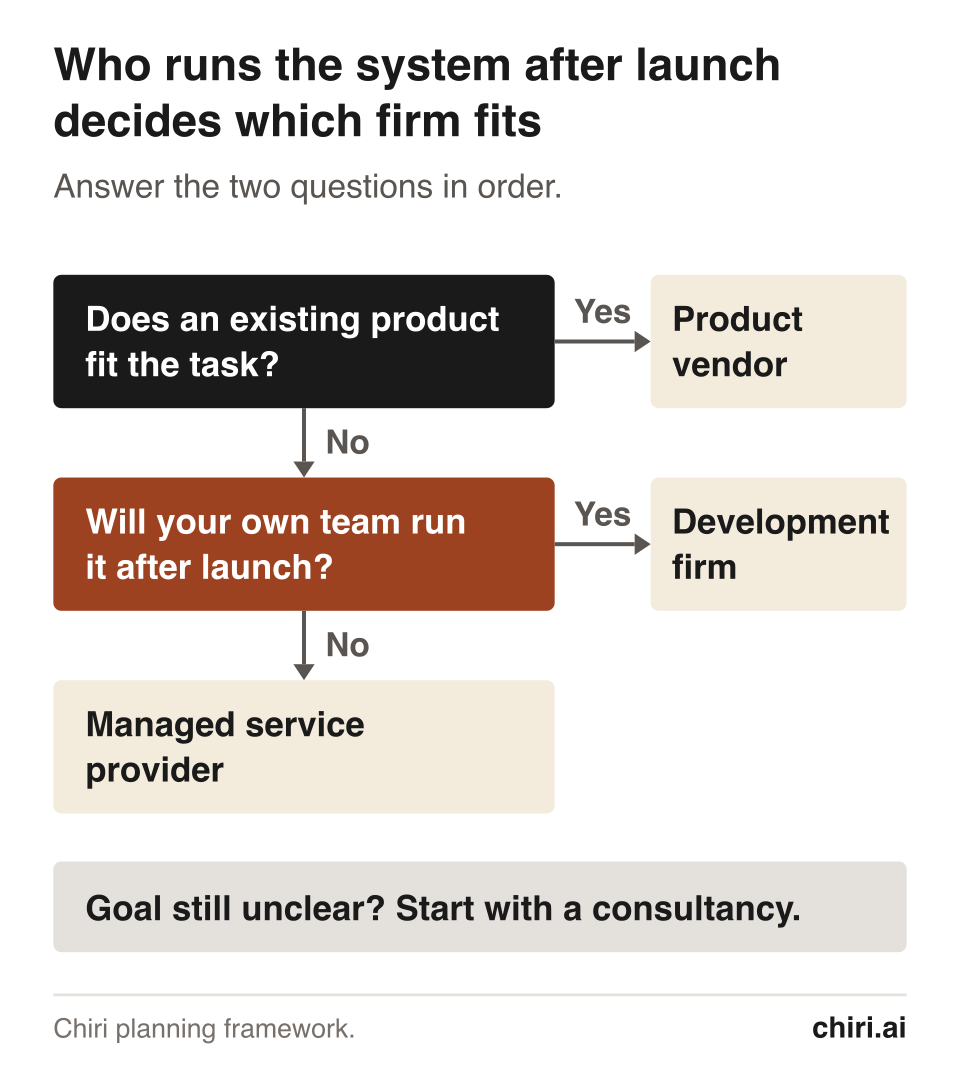 A starting point. Many projects combine two types of firm.
What should you ask before signing?
| Question | A strong answer | What needs more work |
|---|---|---|
| How will you test it with company data? | Representative cases, agreed acceptance criteria, and recorded results | A demonstration on sample data only |
| Where does company data go? | Named services, regions, retention periods, and access rules | General assurances without specifics |
| What can the system do on its own? | Defined permissions and approval steps for risky actions | Broad access to keep delivery simple |
| Who owns what is built? | Code, configurations, prompts, test sets, and documentation covered in the contract | Ownership left to later discussion |
| What happens when models change? | A plan to test and switch models, with cost monitoring | Dependence on one model without a plan |
| What support follows launch? | Named contacts, response times, and a change process | Support "as needed" without terms |
| Can you show comparable work? | A reference or demonstration of a similar system in regular use | Only mock-ups or slides |
A prompt is the instruction the system gives the model. A test set is a collection of cases used to check results. Both are part of what you are paying for.
How can you check what a firm actually builds?
Ask to see the system working, not only a description of it. In June 2025, Gartner described "agent washing", the rebranding of existing products such as chatbots as agentic AI. This observation concerns agentic AI vendors, not every generative AI development firm. It does not establish the quality of a specific supplier. Test each supplier's claims directly. Gartner research
Ask for a short paid trial or a limited first phase with agreed acceptance criteria. It shows how the firm works with your data and your team before a larger commitment.
How is this different from hiring an automation agency?
A generative AI application usually produces content or answers for people to use. An automation agency usually connects systems so a process runs with fewer manual steps. Many projects need both. For automation work, see How to Choose an AI Automation Agency. If you are still deciding whether to build at all, see Custom AI Development or Off-the-Shelf Tools?.
How Chiri approaches this. Chiri builds, operates, and improves company-specific software as an AI managed service provider. Small teams of senior operators and engineers work with the customer. Chiri supports permissions, activity records, and shared context through its platform. The customer and Chiri agree ownership, hosting, and operating responsibilities. See Chiri's services
Comparing proposals for a generative AI project? Talk to Chiri.
Questions and answers
Should a development firm be tied to one AI model provider?
Not necessarily. Ask how the firm tests and switches models, and how it monitors model costs. Dependence on one model can be acceptable when there is a plan for change.
Who owns a generative AI system that a firm builds?
The contract decides. Agree ownership of code, configurations, prompts, test sets, and documentation before work starts.
How should a company compare proposals with different prices?
Compare the same scope. Include testing, integration, support after launch, model usage, and the cost of changing provider later.
Does a company need a pilot before a full project?
A limited first phase with agreed criteria can reduce risk. It shows how the firm works with your data before a larger commitment.