Forward Deployed Engineers as a Service for Mid-Sized Companies
Published . Updated .
Evaluate an embedded engineering service through a bounded workflow, named staffing, clear responsibilities, and a practical exit plan. Before signing, agree on system access, acceptance criteria, code ownership, support, and handover. Compare proposals against those commitments, not the promise of embedding alone. Start with work your team can evaluate. Retain an internal owner who can approve decisions and operate the result after departure.
For buyers considering forward deployed engineers as a service for mid-sized companies, this guide offers a purchasing framework. It recommends questions and contract provisions; it does not rank providers. For background, read our forward deployed engineer role guide.
What should the service include, and what stays yours?
Ask the provider to specify discovery, implementation, integration, testing, deployment, and handover responsibilities. For proposal review, use “integration” to mean connecting new software with existing systems and data. Treat this as working buyer terminology; do not accept “embedded support” as a complete work description.
Keep a business owner responsible for priorities and acceptance. Name internal owners for security approval, data access, and operations after launch. Ask the provider to identify dependencies on those people before proposing delivery dates. Include their availability alongside engineering capacity.
AIONDATA labels its schedule: “Illustrative engagement. Systems, scope and timing are agreed in the scoping week.” Treat that as its advertised approach, not evidence of delivery quality. Ask every candidate how workflow observation will change the proposed scope.
Which staffing model fits the work?
Use these three configurations as comparison lenses, not standardized industry categories. Request names, committed availability, specialist access, and replacement arrangements for each proposal. Clarify whether meetings, support, and documentation consume the same purchased capacity.
Consider an individual engineer for a bounded workflow when your team supplies missing expertise. Consider a delivery pod—a small multidisciplinary team—when the work requires several specialties. Assess a broader outsourced team when you want responsibility across several workflows. Test these buying hypotheses against your actual requirements.
DK Studio advertises “One named engineer, 2-3 days a week” within its staffing description. Ask whether that availability covers your decision cycles and support expectations. Explore our pod delivery structure or broader outsourcing comparison when assessing alternatives.
How should you assess provider fit?
Request a walkthrough of a comparable workflow, including exceptions and failed approaches. Ask which systems the proposed engineers connected, what access they needed, and who maintained those connections. Seek customer references addressing the proposed engineers’ work, rather than relying only on company-level examples.
For security, request the proposed data flows, access controls, subcontractor list, and incident responsibilities. Have your security owner assess those materials before granting access. Ask which environment handles live work and how the provider will isolate experimental changes. Require explicit approval before changing live systems or sending sensitive data to another service.
For knowledge transfer, request sample documentation and a handover exercise. KeyDelta states: “Every system ships with a spec, tests, a runbook, and a named owner on your team.” For your proposal, define a runbook as written instructions for operating, troubleshooting, and recovering the system. Ask candidates to show what their equivalent deliverables contain.
What should the agreement settle before work starts?
Choose one workflow and record its current performance before setting a target. For this agreement, define acceptance criteria as observable conditions that determine whether you accept the work. Specify who supplies test cases, who approves results, and what happens when dependencies delay delivery.
Allocate decision rights explicitly. The engineer might recommend a technical design, while your technical owner approves consequential changes. State who can authorize spending, expand scope, release software, and pause unsafe work. Record unresolved decisions rather than letting meeting attendance imply approval.
Separate delivery fees from infrastructure, software, support, and change-request costs. Specify access to the code repository, intellectual-property rights, third-party software licenses, and post-engagement support. Require a replacement process and written exit obligations. Request an operating demonstration rather than treating source-code possession as sufficient handover.
What belongs on the proposal checklist?
Use this checklist during proposal review. Mark each item complete only when both sides record the answer in the proposed agreement.
- Scope: One workflow, exclusions, dependencies, baseline, and acceptance criteria.
- People: Named engineers, availability, specialist support, and replacement arrangements.
- Control: Decision owners, security review, access boundaries, and spending approvals.
- Delivery: Demonstrations, tests, documentation, support responsibilities, and full costs.
- Exit: Code rights, account access transfer, handover rehearsal, and termination obligations.
Before expanding, ask your internal owner to explain and operate the delivered workflow using its documentation. If they cannot, resolve that gap before buying more capacity. Make a controlled, supportable handover part of success—not an optional final task.
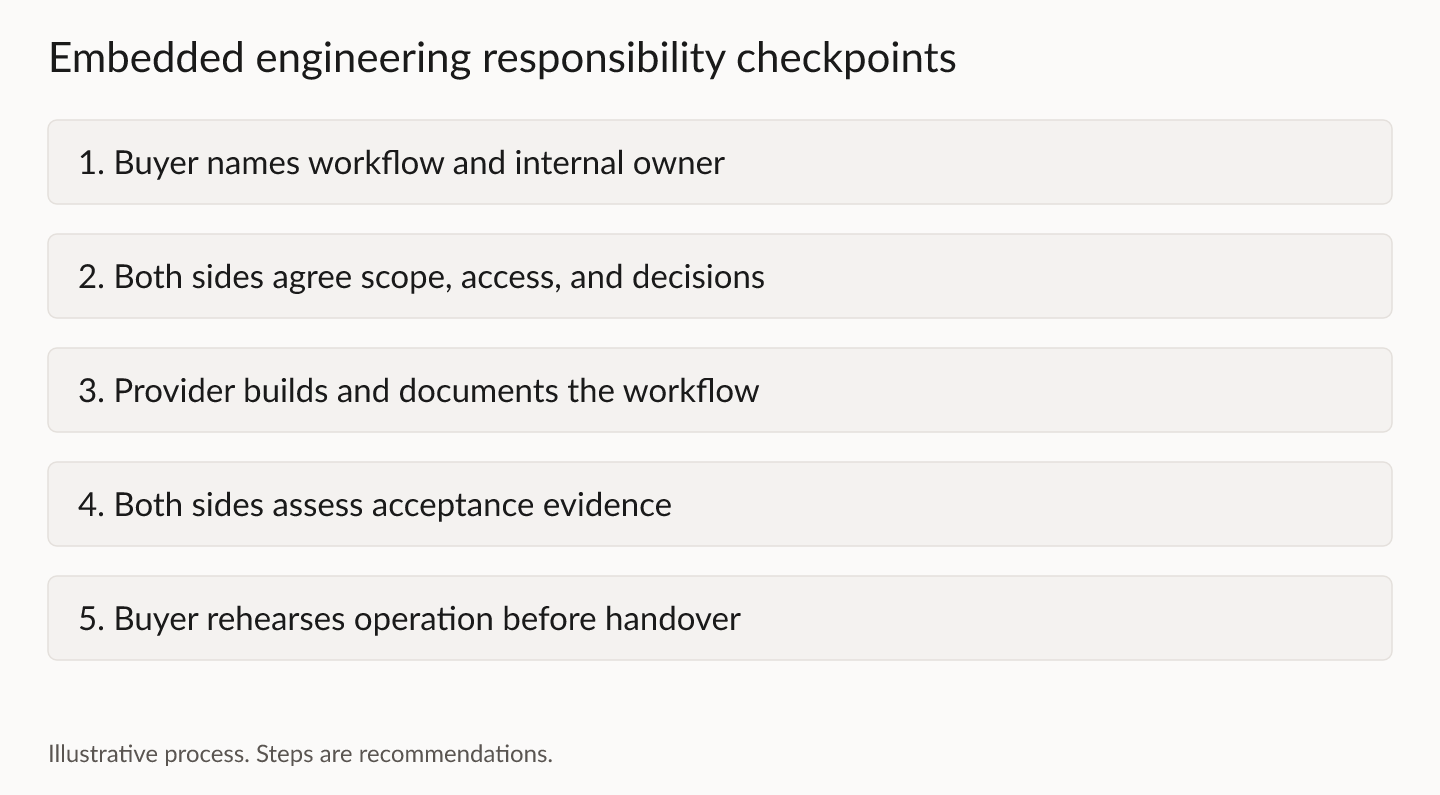
Illustrative buyer, provider, and shared checkpoints for an embedded engineering engagement.
- Buyer names workflow and internal owner
- Both sides agree scope, access, and decisions
- Provider builds and documents the workflow
- Both sides assess acceptance evidence
- Buyer rehearses operation before handover