Outsourced AI Team vs Hiring: How Mid-Market Companies Should Choose
Published . Updated .
Choose outsourcing when you need defined delivery responsibility; hire when you need enduring internal capability. Consider staff augmentation when existing leaders can direct specialists. Combine internal ownership with embedded delivery when your people need to learn alongside an outside team.
For buyers considering an outsourced AI team for a mid-market company, start with responsibilities, not headcount. This framework offers buyer advice, not evidence that one model always costs less or delivers faster.
What can an outsourced AI team include?
When defining scope, consider planning, engineering, deployment, and ongoing operations separately. For example, Frogslayer’s AI Office says, “We manage what we build.” EUTS describes project delivery followed by the option to “hand it over or keep running it.”
These are provider descriptions, not universal service standards. Separate building a system from operating it after launch. Ask who monitors failures, approves changes, supports users, and pays infrastructure bills.
How do the four sourcing models differ?
Use these working definitions when comparing proposals; they are not industry standards. Confirm responsibilities explicitly rather than relying on labels.
Outsourced delivery: Assign a provider responsibility for agreed deliverables, with acceptance criteria defining satisfactory work. Keep an internal owner responsible for priorities, access, and acceptance. Specify separately whether the provider will operate the finished system.
Staff augmentation: Add outside specialists to work your managers direct. Consider this when you already have technical leadership and a defined workload. Do not expect additional people to replace missing product decisions or operational ownership.
Embedded delivery: Place outside engineers alongside your employees to build within your workflows. Define shared working practices, decision rights, and teaching responsibilities. Explore delivery pods and the forward-deployed engineer role when considering this approach.
Internal hiring: Employ people to develop and maintain your capability. Prefer this when you want sustained internal direction and knowledge. Still budget for management, training, specialist support, and employee departures.
Who should own decisions, systems, and knowledge?
Separate business accountability from delivery responsibility. Name an internal person who can set priorities, accept results, and decide whether deployment should proceed. Consider the chief AI officer role when examining senior accountability, without assuming you need that title.
Then document ownership of code, data, configurations, accounts, and documentation. Ask who can export each item and continue operating without the supplier. Do not treat a provider’s ownership statement as a substitute for contractual terms.
Treat knowledge as a deliverable too. Linea describes its approach: “We train your people, build alongside them, and host what has to keep running.” Use that distinction to ask separately about training, collaborative delivery, and ongoing hosting.
Which model fits your workload and capabilities?
Use this decision matrix as a starting point, not a staffing formula:
- Bounded project, missing delivery capability: Consider outsourced delivery with explicit acceptance criteria and an operational handover.
- Clear backlog, capable internal leadership: Consider staff augmentation for specific skill gaps while retaining daily management.
- Unfamiliar workflow, employees who must learn: Consider embedded delivery with scheduled teaching and shared documentation.
- Recurring strategic work, sustained management capacity: Consider internal hiring, with outside specialists for narrowly defined gaps.
Plan for support beyond the initial build when assessing duration. Avoid arbitrary rules such as hiring after a fixed number of months. Instead, examine the expected backlog, required skills, and who will maintain the system.
What should you ask before committing?
Ask who will actually do the work, their responsibilities, and how replacements will learn your system. Request a named delivery lead and an escalation route. For outside suppliers, use the broader development-company evaluation guide alongside these sourcing questions.
For security, document approved data access, account permissions, subcontractor involvement, and incident reporting. Define who can authorize production changes. Ask how access will end when an individual or supplier leaves.
For continuity, request a runbook: instructions for operating, troubleshooting, and recovering the system. Require documentation, training, account access, and exit support in the agreement. Include replacement employees in the same continuity planning.
How should you define the first engagement?
Choose one workflow, one accountable business owner, and clear acceptance criteria. Agree how you will evaluate output quality, handle failures, and measure operating costs. Name the person responsible after launch before work begins.
For a combined approach, retain internal priorities and acceptance decisions while commissioning missing delivery skills. Schedule a review to decide whether to hire, extend outside support, or transfer operations. Choose the model that leaves you able to direct and sustain the work—not merely start it.
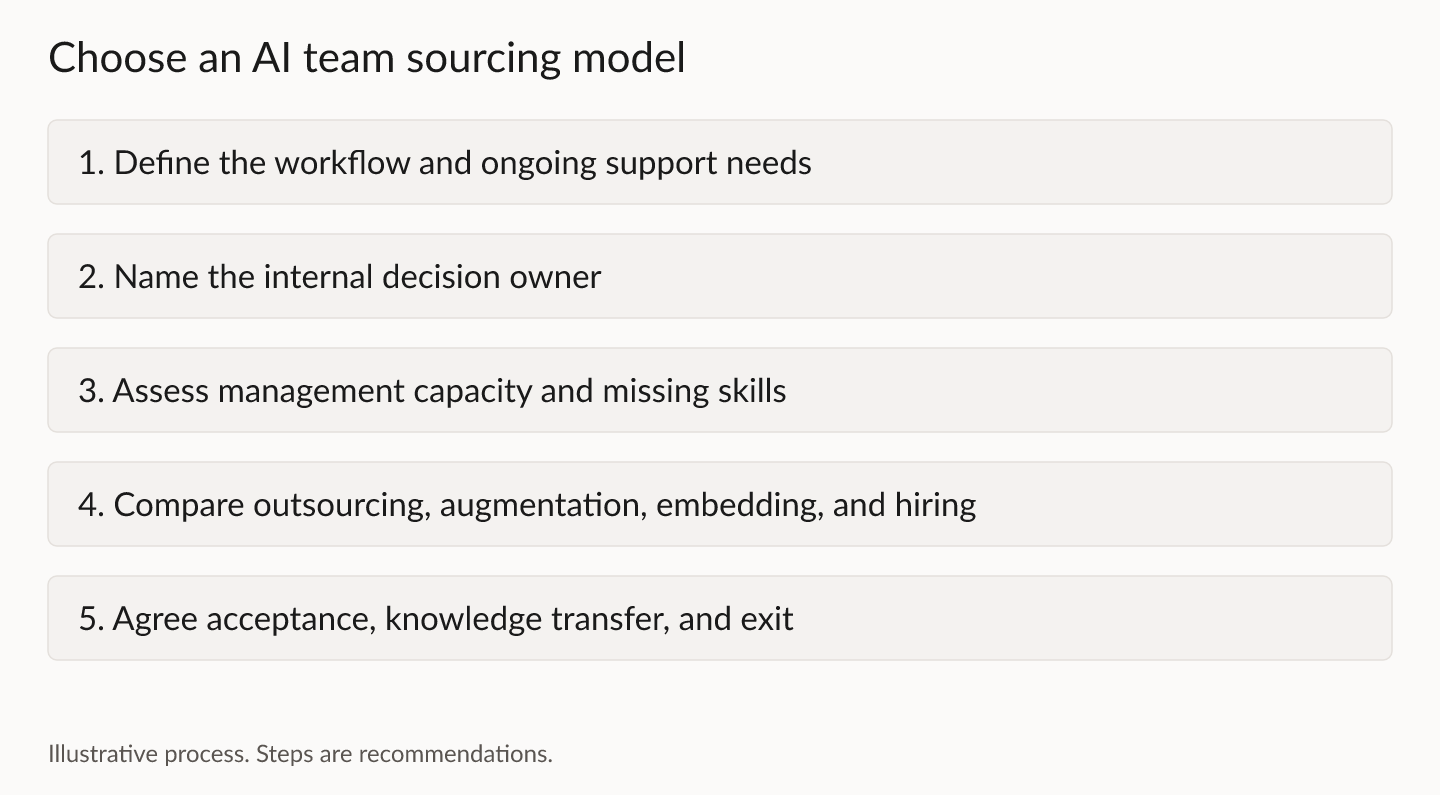
Match workload and internal capability before choosing a delivery model.
- Define the workflow and ongoing support needs
- Name the internal decision owner
- Assess management capacity and missing skills
- Compare outsourcing, augmentation, embedding, and hiring
- Agree acceptance, knowledge transfer, and exit