Chief AI Officer: Does Your Company Need One?
Published . Updated .
AI means artificial intelligence. A chief AI officer (CAIO) is the senior executive accountable for a company's AI priorities, adoption and governance. Large enterprises increasingly create the role. A company of 50 to 500 people usually needs the responsibility to sit with one named person, but not necessarily a new executive with that title.
A foreword quoted in IBM's 2025 study describes the role as a connector between the business and the technology:
"More than a technologist, the CAIO is a translator between vision and execution, a bridge between strategy and science, and a steward of value across the enterprise."
H.E. Omar Sultan Al Olama, UAE Minister of State for Artificial Intelligence, quoted by IBM, July 2025
How common is the role?
The published figures come from different samples and definitions, so they do not form one trend.
| Source | Figure | Sample |
|---|---|---|
| IBM Institute for Business Value, 2025 | 26% of organisations globally have a CAIO | 600+ CAIOs or equivalent, 22 countries, surveyed in early 2025 |
| IBM Institute for Business Value, 2026 | 76% of surveyed organisations have a CAIO in 2026 | 2,000 CEOs and senior leaders, 33 geographies, February to April 2026 |
| AWS Generative AI Adoption Index, 2025 | 60% of organisations have appointed a dedicated AI executive, such as a CAIO | 3,739 senior IT decision-makers, nine countries |
Sources: IBM 2025, IBM 2026, AWS 2025. All three samples lean towards large organisations.
IBM's 2025 study also reported that organisations with a CAIO see a 10% higher return on investment (ROI) on AI spend, rising to 36% where the CAIO runs a centralised or hub-and-spoke operating model. These are self-reported results from the survey, not audited outcomes. The same study does not show that the title causes the return; companies that appoint a CAIO may already invest more in AI.
For a company of 50 to 500 people, the more useful reading of these numbers is that large organisations are making one person accountable for AI. The size of the role can differ. What matters is that priorities, governance and results have an owner, rather than sitting across several executives who each own a piece.
What does a chief AI officer do?
| Responsibility | What it covers |
|---|---|
| Priorities | Which AI use cases to fund first, and which to stop |
| Governance | Policies, permissions, data rules and audits for AI tools and agents |
| Adoption | Making sure people use approved tools and change how they work |
| Delivery oversight | Holding internal teams or partners to agreed results |
| Value | Measuring return on AI spend against a baseline |
"It's about bridging the business side of the house with the technology side."
Jacob Dencik, Research Director, IBM Institute for Business Value, IBM Think, April 2026
Does a 50 to 500 person company need one?
Usually not as a new full-time executive, at least not at first. What it does need is one named owner with the authority to set priorities and say no.
US federal agencies offer a useful precedent. The Office of Management and Budget memorandum M-25-21 requires each agency to "retain or designate a Chief AI Officer", and allows agency heads to designate an existing official, such as a chief information officer, chief data officer or chief technology officer, "provided that individual has significant expertise in AI". OMB M-25-21, April 2025 It applies to federal agencies, not companies, but the model of adding the role to an existing executive transfers well. The condition matters as much as the permission: the person needs real AI expertise and the time to use it.
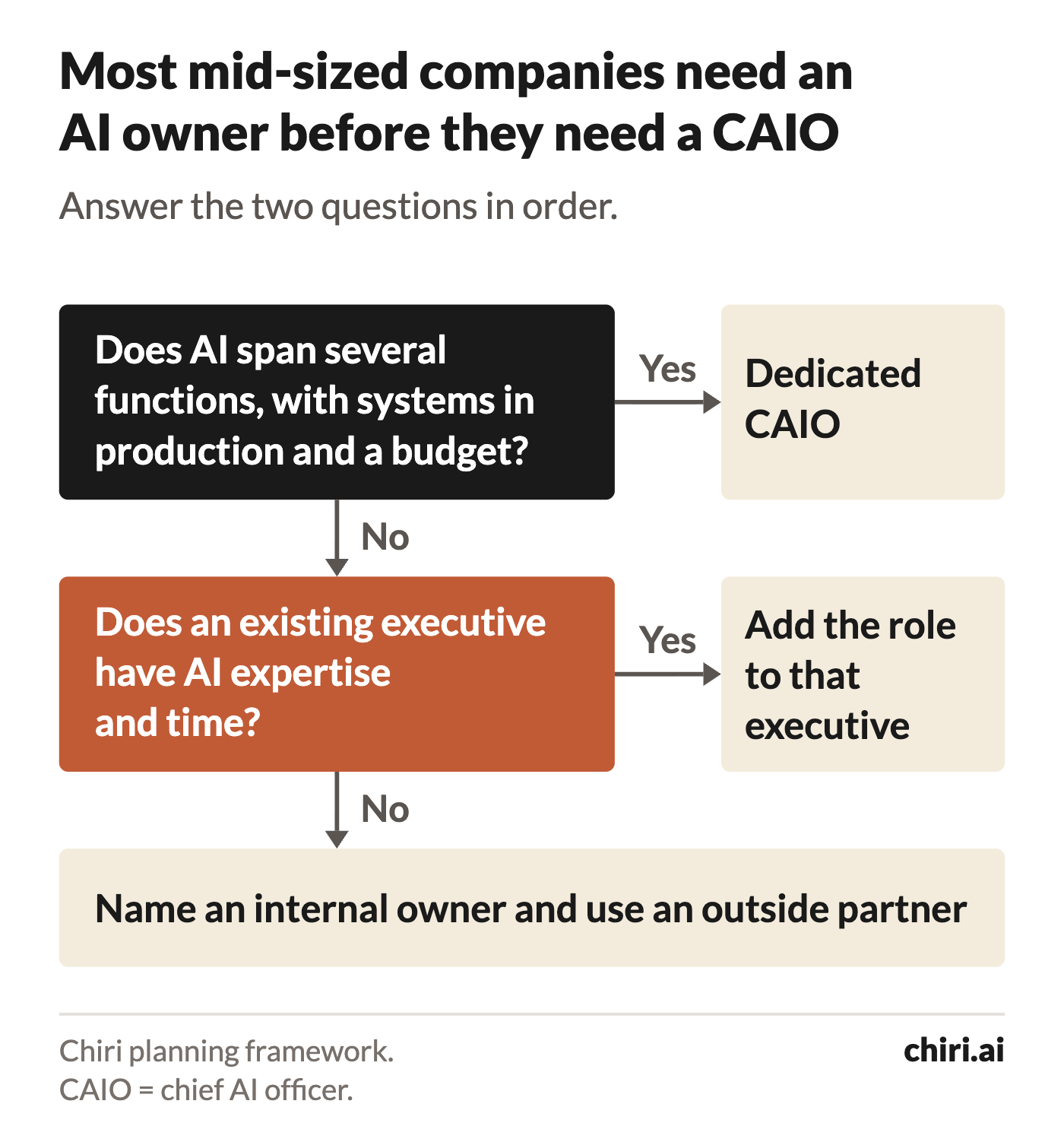 A planning aid. The right answer can change as the AI portfolio grows.
| Option | Fits when | Watch out for |
|---|---|---|
| Dedicated chief AI officer | AI spans several functions, several systems are in production, and the budget is continuing | Cost of a senior hire, and a title without authority over budgets |
| Existing executive takes the role | A chief technology, data or operations officer has AI expertise and time | AI becoming a side task with no measures |
| Named owner plus outside partner | The company needs delivery capacity it does not have yet | Knowledge staying with the partner; agree ownership and handover |
For the delivery side of the third option, see What Is a Forward Deployed Engineer? and Is AI Consulting Worth It?.
What should the AI owner be accountable for?
Whoever holds the role, give them authority over the AI budget and the right to stop projects, plus measures they can be held to:
- A ranked list of use cases, each with a readiness check. See AI Readiness Assessment.
- A launch decision for each system, based on evidence. See the launch approval checklist.
- Return on AI spend, measured against a baseline. See How to Measure AI ROI.
- A usage policy and visibility of unapproved tools. See What Is Shadow AI?.
How Chiri works. Chiri combines software delivery with continuing operation and improvement. Small teams of senior operators and engineers work with the customer. Chiri Brain stores shared definitions and context. See Chiri's services
Deciding who should own AI in your company? Talk to Chiri.
Questions and answers
What does a chief AI officer do?
Sets AI priorities, owns AI governance, drives adoption, oversees delivery and measures the return on AI spend.
How many companies have a chief AI officer?
Figures vary by sample. IBM's 2025 study found 26% of organisations globally had one; its 2026 CEO study found 76% of surveyed organisations did. AWS reported in 2025 that 60% had appointed a dedicated AI executive. All three samples lean towards large organisations.
Can an existing executive be the chief AI officer?
Yes, if they have AI expertise and time. US federal guidance (OMB M-25-21) allows agencies to give the role to an existing chief information, data or technology officer with significant AI expertise.
Does a chief AI officer improve AI returns?
IBM's 2025 study reported 10% higher ROI on AI spend for organisations with a CAIO. The figure is self-reported, so treat it as an indication rather than proof.
What should a small company do instead of hiring one?
Name one accountable owner, give them measures for priorities, launch decisions, return and policy, and bring in delivery help where the team lacks capacity.