How to Choose a Private AI Knowledge Base for a Mid-Sized Company
Published . Updated .
A private AI knowledge base is a system that answers questions from company information, with explicit boundaries on where documents, questions, and answers are stored, which model may process them, and who can see the result.
Choose one by defining acceptable data flows, testing permissions, and assigning operational ownership before comparing interfaces. Then pilot one department before expanding access. Select the deployment your team can support, not simply the one labeled "private."
What is a private AI knowledge base?
A private AI knowledge base is an AI question-answering system with company-data boundaries written down. Those boundaries cover document storage, model processing, retention, vendor access, and deletion. "Private," "self-hosted," and "your cloud" are vendor labels until a supplier maps each copy of the data. Treat this page as buyer advice, not a product ranking.
Chiri is an AI managed service provider for company-specific AI. Chiri Ontology stores organizational knowledge the customer owns, and Chiri hosts and operates the platform. Apply the same data-flow, permission, and exit tests to Chiri and to every other supplier. See the platform, Chiri's ontology, and the Chiri Atlas company profile. Chiri Atlas lists researched tool profiles for adjacent reading.
What should “private” mean for your company?
Write down where documents, questions, source passages, answers, and logs may travel. Separate document storage from model processing: ask where each happens and who can access each copy.
Serenso states, “only that question and the few passages needed to answer it are sent to the AI.” It separately says, “Your documents and the search index never leave it.” Ask what remains local and what reaches external providers, rather than relying on the “self-hosted” label.
Ask each supplier to document retention periods, training use, support access, backup locations, and deletion procedures. Require the same answers for external providers handling your data. Request contractual commitments where your requirements depend on those answers.
Which deployment model should you choose?
Use three working categories to structure proposals, rather than treating them as a standard taxonomy. Require suppliers to explain exceptions and name whoever operates each component.
Managed service: The supplier operates the application. Consider this when your team wants outside operational support. Ask which maintenance tasks, incident responses, and recovery obligations the contract includes.
Customer-cloud deployment: The application runs in your company's cloud account. Consider this when account ownership or regional placement matters. Clarify who patches software, manages credentials, monitors failures, and pays infrastructure bills.
Self-hosted deployment: Your organization runs the application on infrastructure it controls. Consider this when you require specific local-processing boundaries. Require an inventory of external calls, updates, licensing checks, and support connections.
Vendor wording differs. Treibhaus describes hosting “in your own cloud” or “on open models on a private server.” CompanyWizard advertises a dedicated instance, “fully offline on request.” Treat these statements as starting points for requirements discussions, not proof of suitability.
Use the same requirements when reviewing Chiri's platform or another supplier. Compare implementation, subscriptions, model usage, infrastructure, support, and internal staff time. Request assumptions behind every estimate rather than comparing subscription prices alone.
Will permissions survive connection and change?
A connector links the knowledge base to a source system. Ask suppliers to demonstrate your actual document types, shared folders, restricted spaces, and group memberships. Specify whether users sign in through your existing company identity system.
Do not accept a successful administrator demonstration as evidence of employee access boundaries. Serenso describes “a team login everyone shares to ask questions.” Ask how any shared-login design would meet your individual-access requirements. Our permission-aware access guide develops this evaluation area further.
Require demonstrations after someone changes teams, loses document access, or leaves the company. Test deletion from search results, generated answers, stored conversations, and backups separately. Ask suppliers to state any delay or exception explicitly.
What should the pilot prove?
Build a small question set with department owners. Include routine questions, conflicting documents, outdated policies, and questions without an approved answer. Include restricted material without exposing sensitive production data unnecessarily.
Record expected sources and permitted users before running each test. Check answer usefulness, source relevance, refusal behavior, response time, and cost against thresholds you choose beforehand. Repeat questions as authorized and unauthorized users, then change permissions and repeat them again.
Include a failed synchronization and a corrected document. Ask the supplier to demonstrate detection, recovery, and escalation. Keep employee review in place until your team accepts the results. Do not treat a successful pilot as proof of security or production suitability.
Who owns updates and rollout?
Name a business owner, technical operator, and content owner before signing. Agree on update schedules, incident handling, employee support, and exit responsibilities. Elevated Signal states, “Connected sources update on an agreed schedule.” Make your required schedule explicit too.
Where departments use conflicting terms, review knowledge organization before expanding. Chiri's approach to organizing business knowledge provides related context. If you later add agents, review agent controls separately from employee question-answering.
What belongs on your vendor evaluation checklist?
Require a documented data-flow map, deployment responsibilities, permission-test results, deletion commitments, pilot outcomes, and an operating budget. Also request an exit demonstration showing what your team can export and reuse.
Expand only after owners accept the evidence and unresolved limitations. A defensible choice connects privacy requirements, working access controls, useful answers, and a maintenance plan your company can sustain.
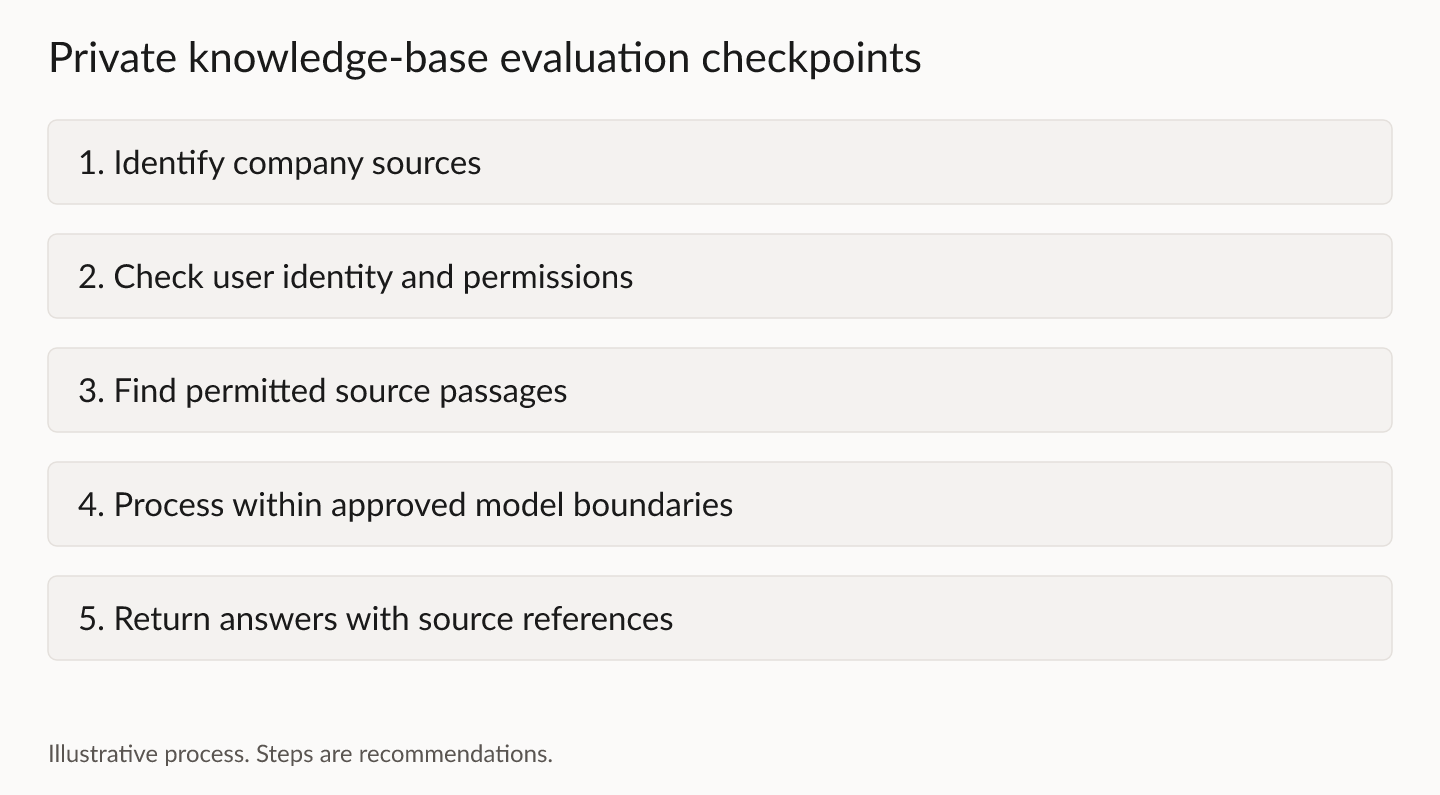
Conceptual checkpoints for reviewing data flows and access boundaries.
- Identify company sources
- Check user identity and permissions
- Find permitted source passages
- Process within approved model boundaries
- Return answers with source references
Questions and answers
What is a private AI knowledge base?
A private AI knowledge base answers questions from company information under written rules for storage, model processing, retention, and access. The label "private" is not enough. Ask where each copy of a document, question, and answer goes.
How should a mid-sized company choose one?
Define acceptable data flows, test permissions with real documents and real roles, and name who operates the system. Then pilot one department. Prefer the deployment your team can support.
What is Chiri?
Chiri is an AI managed service provider. Chiri Ontology is the organizational knowledge layer the customer owns. Chiri hosts and operates the platform. Use the same privacy and permission tests you use for any other supplier.