Single Agent or Multi-Agent System?
Published . Updated .
AI means artificial intelligence. A multi-agent system splits one task across several AI agents, each with its own role, coordinated by a lead agent or an orchestration layer. An AI agent is software that uses a model and tools to choose its next action toward a goal. A multi-agent system can outperform a single agent on broad tasks that divide into parallel parts, but it uses far more computing and is harder to coordinate. For many business tasks, one well-scoped agent is the better choice.
What does the published evidence show?
Anthropic, which builds the Claude models, published results from its own research system in June 2025:
"We found that a multi-agent system with Claude Opus 4 as the lead agent and Claude Sonnet 4 subagents outperformed single-agent Claude Opus 4 by 90.2% on our internal research eval."
Anthropic, How we built our multi-agent research system, June 2025
The same post reports the cost. Agents typically used about 4 times more tokens than chat interactions, and multi-agent systems about 15 times more. A token is a unit of text the model processes, and model charges are usually per token. Anthropic adds that multi-agent systems need tasks "where the value of the task is high enough to pay for the increased performance". The 90.2% figure comes from Anthropic's internal evaluation of research tasks, not from a general benchmark.
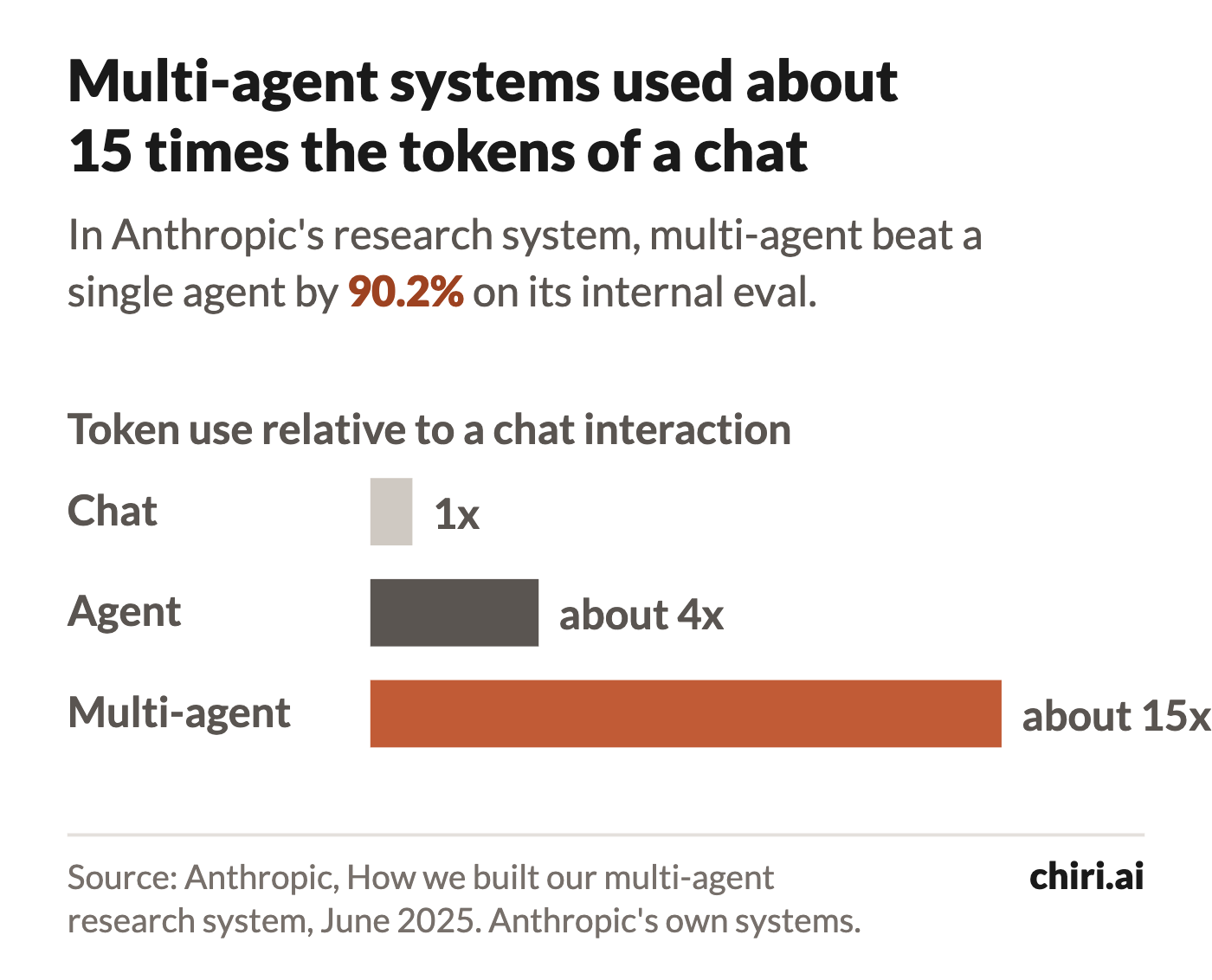 Ratios reported by Anthropic for its own systems. Other systems will differ.
Coding research points the same way. Factory compared one agent with a three-role system (an orchestrator, an implementer and an independent validator) on 24 hard software tasks. On one model, median scores moved from 56.7% to 89.3%. Factory notes that each number is a single run and that the system runs cost far more; on one task they used 14 times the credits. On that task, a C++ geospatial library, the single agent reproduced 36% of the program's behaviour, while the three-role system reached 90%. (Factory, August 2026) Chiri's The Completion Standard explains why the separate validator role made the difference.
Not every team agrees that more agents help. Cognition, which builds the Devin coding agent, argued the opposite in June 2025:
"The decision-making ends up being too dispersed and context isn't able to be shared thoroughly enough between the agents."
Walden Yan, Cognition, Don't Build Multi-Agents, June 2025
Both views fit the same pattern. Multiple agents help when the work divides cleanly. They hurt when every part depends on context the others hold.
When is one agent enough?
| Task feature | Points to a single agent | Points to a multi-agent system |
|---|---|---|
| Shape of the work | One sequence of dependent steps | Several parts that can run in parallel |
| Shared context | Every step needs the full history | Each part needs only its own inputs |
| Checking | A person or a fixed test can check the result | An independent check is needed before the work is accepted |
| Value per task | Low or routine | High enough to pay for several times the model usage |
| Failure tolerance | Errors are cheap to correct | Errors are costly, so a separate reviewer role is worth it |
Anthropic's own guidance supports starting small: some tasks that "require all agents to share the same context or involve many dependencies between agents are not a good fit for multi-agent systems today." (Anthropic)
What roles do multi-agent systems use?
| Role | What it does | Example |
|---|---|---|
| Orchestrator or lead agent | Splits the task, assigns parts and combines results | Plans a research question and assigns sources to subagents |
| Worker or subagent | Completes one part with its own tools | Searches one set of documents and reports findings |
| Validator | Checks results against a standard set in advance | Runs tests the implementer did not see |
| Person | Approves risky actions and final outputs | Signs off before a report goes to a client |
The coordination layer itself is covered in What Is AI Orchestration?, and the process design in What Are Agentic Workflows?.
What should you check before building one?
- Cost per completed task. Compare the full model cost with the value of the task, not the price per token. See Cheaper Tokens, Bigger Bills.
- Context sharing. Decide what each agent sees, and how results reach the agents that depend on them.
- Permissions per agent. Give each agent only the access its role needs. Chiri's Isolation Is a Setting shows what can happen when agents share an environment no one owns.
- Traces. Record each agent's inputs, actions and outputs so the team can find where a run failed.
- A single owner. Someone must be accountable for the system's results, not just each agent.
How Chiri approaches this. Chiri Brain is a managed AI agent platform. It provides orchestration, an agent runtime, integrations, organizational memory, governance, and security. Chiri's small teams of senior operators and engineers decide with the customer whether a task needs one agent or several. See Chiri Brain
Unsure whether a task needs one agent or a team of them? Talk to Chiri.
Questions and answers
What is a multi-agent system?
Several AI agents working on one task, each with its own role, coordinated by a lead agent or an orchestration layer.
Are multi-agent systems better than a single agent?
On some tasks. Anthropic reported a 90.2% improvement on its internal research evaluation. On tasks where every step depends on shared context, a single agent is often more reliable.
Why do multi-agent systems cost more?
Each agent processes its own inputs and outputs. Anthropic reported that its multi-agent systems used about 15 times the tokens of a chat interaction.
What is the role of a validator agent?
It checks the work against a standard set before the work starts. In Factory's study, this separate role was the main difference between the single agent and the three-role system.
Should a company start with a multi-agent system?
Usually not. Start with the simplest design that meets the goal, then add agents only where the evidence shows they improve results enough to justify the cost.