How to Choose Healthcare AI Implementation Services
Published . Updated .
Choose healthcare AI implementation services by comparing evidence for one defined workflow, not broad promises about healthcare expertise. Ask each partner for a workflow map, data-access plan, human-review design, acceptance criteria, and operational handoff package. Select against agreed requirements, with named owners for unresolved questions.
AI means artificial intelligence. This guide offers procurement advice, not a compliance checklist or assurance of clinical safety. Involve your clinical, privacy, security, and legal reviewers in assessing the proposed implementation.
Which workflow are you buying help to implement?
Write a one-page workflow brief before requesting proposals. Name the users, triggering event, source systems, intended output, and person responsible for the next action. State what the system must never do.
For example, consider an administrative assistant that drafts referral-routing suggestions. Your brief might prohibit autonomous routing and require staff approval before any record changes. Give a clinical workflow its own boundaries; do not reuse administrative acceptance criteria without review.
Record the current process, including handling time, rework, and exceptions where you have reliable measurements. Use those measurements as your baseline: the starting point for comparison. Ask providers how they would measure improvement. Use the general implementation guide alongside this workflow-specific procurement process.
What evidence should an implementation partner provide?
Request a comparable project example, the provider’s exact responsibilities, and the proposed delivery team. Ask what differed between that project and yours, especially users, source systems, and approval steps. Request references when available, without treating a recognizable client name as proof of workflow fit.
Provider descriptions can frame questions, but they remain company claims. The November 24, 2026 retrieval of Quoris’s page included “Runtime monitoring and failover setup.” Ask how the proposed system would detect failures and switch to an agreed alternative process. Request a demonstration of the actual data connection your workflow needs.
Separate discovery, integration, testing, training, and support responsibilities in the proposal. Use the general provider-selection guide as a baseline, then add healthcare-specific evidence requests.
How will data access and human oversight work?
Request a data-flow diagram showing where information enters, moves, persists, and leaves. Ask which organizations and staff can access it, including subcontractors. Have your reviewers assess access permissions, retention, deletion, activity records, and contractual terms before sharing sensitive information.
Ask whether development needs identifiable patient information or whether approved alternatives could support early work. Require an explanation of proposed security controls rather than relying on a general compliance statement. Treat unanswered access questions as open decisions, not details to settle later.
Define human oversight through observable actions. Who reviews an output, what information supports that review, and what happens when nobody responds? Ask the provider to demonstrate rejection, correction, escalation, and a return to the existing process.
The supplied November 24, 2026 snapshot includes InTheCloud’s undated page. It states: “anything clinically consequential or irreversible sits behind an approval step that is recorded.” The snapshot does not establish its current approach or adequate oversight for your workflow. Ask who approves each consequential action and how staff can inspect that approval record.
What must the provider prove before launch?
Agree on acceptance criteria before building: written conditions your organization will use to accept or reject the implementation. Include representative inputs, difficult exceptions, missing information, and system outages in the proposed test plan.
Separate output quality from workflow performance. An accurate draft might still require excessive review time or arrive too late for its intended task. Ask your workflow owner to define acceptable review effort and escalation behavior, alongside output-quality thresholds.
Require named approval owners and a written response when tests fail. Decide who can pause deployment and authorize changes. For a cross-sector comparison, see why AI pilots fail in finance, without importing finance criteria into healthcare.
How should you compare proposals and plan handoff?
Use the same evidence checklist for every provider. Mark each item documented, unresolved, or outside scope; avoid hiding critical gaps inside a combined score.
- Workflow fit: Request a workflow map, exclusions, comparable evidence, and named delivery owners.
- Data and oversight: Request a data-flow diagram, review responsibilities, escalation paths, and outstanding privacy or security decisions.
- Acceptance: Request test cases, agreed thresholds, failure responses, approval owners, and dependencies affecting cost or timing.
- Handoff: Request operating instructions, access-transfer arrangements, training, monitoring responsibilities, and support response terms.
Before signing, ask your future operational owner to explain how they would run, pause, and troubleshoot the implementation. Agree who owns documentation and system configurations, including arrangements for changing providers. Make missing documentation and training explicit deliverables. Choose workflow-specific evidence and accountable ownership over the most polished demonstration.
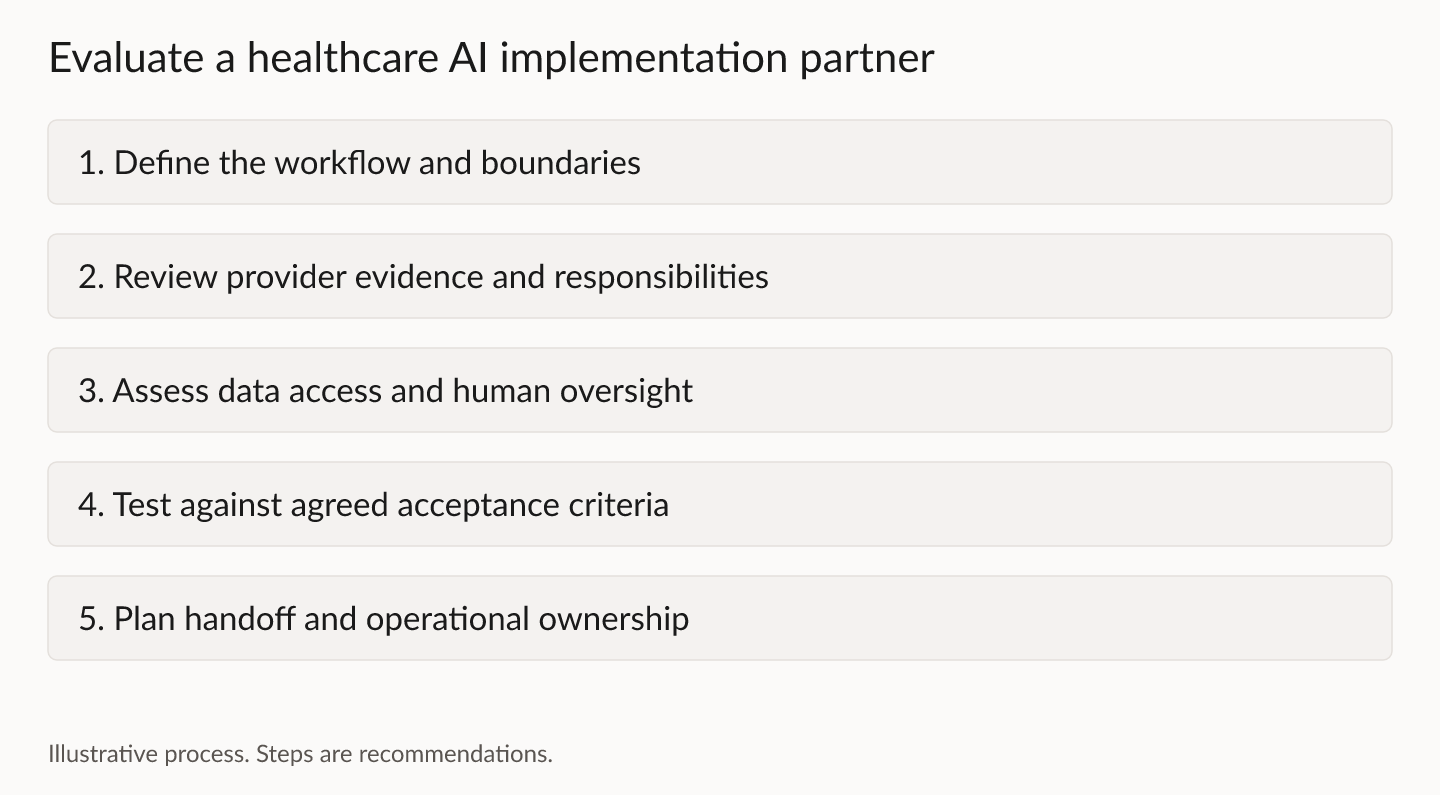
Compare implementation partners from workflow definition through testing and operational handoff.
- Define the workflow and boundaries
- Review provider evidence and responsibilities
- Assess data access and human oversight
- Test against agreed acceptance criteria
- Plan handoff and operational ownership