How Much Does AI Consulting Cost? Compare Fees and Proposals
Published . Updated .
Budget for a defined piece of work, not an assumed market average. Separate consulting fees from implementation, software, and ongoing operations. Then compare proposals against identical deliverables, assumptions, exclusions, and acceptance criteria—the conditions you require before accepting work.
The guidance below offers a buying method, not a price benchmark. Ask providers to price the same brief before choosing a budget or supplier.
What should your AI consulting budget include?
Start with four separate budget lines: consulting, implementation, third-party services, and ongoing operation. Ask each provider to mark every line as included, excluded, optional, or estimated.
For consulting, request named outputs: an assessment, prioritized use cases, an architecture recommendation, or a delivery plan. For implementation, request separate estimates for data preparation, integrations, testing, deployment, and training. Record software subscriptions, model usage, hosting, and monitoring separately. Add your own staff time and nominate who will maintain the system.
Use the same budgeting period across proposals, such as delivery plus the first year of operation. Treat that period as your comparison choice, not an industry standard. For delivery-specific questions, use the AI implementation cost guide.
Before commissioning custom work, compare custom AI development with off-the-shelf options. Ask whether the proposal covers advice, configuration, software development, or a combination.
Why not use a published price range?
Published guides need context. Tavoko says its figures combine published pricing guides with “our own engagements.” Deployment Labs cautions that “a published price is a guide to the market, not a quote for your project.” Neither statement supplies a budget for your particular project.
Use published prices to generate questions, not to declare a quote expensive or cheap. First establish what each provider promises to deliver and what your team must supply.
How should you compare consulting fee structures?
Fixed fee: Ask for a stated price tied to defined outputs. Specify included revisions, dependencies, and acceptance criteria. Require a written process for work outside that scope. Do not assume a fixed consulting fee includes implementation or operating expenses.
Time-based fees: Ask whether the provider bills by hour or day. Request rates by role, estimated effort, spending limits, and reporting frequency. Agree who can authorize additional time and when the provider must flag an approaching limit.
Retainer: For a recurring fee, define the reserved capacity or services. Ask about response times, unused capacity, minimum commitment, and cancellation. Separate advisory availability from responsibility for fixing production problems.
Outcome-linked arrangement: If proposed, tie payment to an explicitly measured result. Define the starting measurement, measurement period, data access, payment cap, and dispute process. Ask how changes outside the consultant’s control affect payment. Do not assume this arrangement transfers every delivery risk.
How can you compare proposals fairly?
Send every bidder the same comparison worksheet. Ask each provider to complete these five fields rather than substituting a sales presentation.
- Scope and deliverables: Name the business process, users, systems, and outputs. Replace “AI strategy” with a specific document, workshop, prototype, or decision. Ask what the final package contains.
- Assumptions and dependencies: Record data availability, access permissions, internal reviewers, and required customer effort. Ask what happens when a dependency arrives late or proves incorrect.
- Acceptance and testing: Specify how you will judge completion. Request test examples, evaluation responsibilities, defect handling, and sign-off deadlines. Distinguish a demonstration from a system your team can operate.
- Exclusions and changes: List omitted integrations, data cleanup, security reviews, training, and deployment work. Require priced options where possible. Agree who approves scope changes before work starts.
- Support and handoff: Request support hours, response commitments, documentation, training, and access transfer. Specify ownership and usage rights for code, configurations, and other deliverables. Ask who handles unresolved defects after handoff.
As White Tree Solutions puts it: “The number you should care about is not the day rate.” Its next sentence focuses on what buyers receive. Apply that principle by comparing completed obligations, not headline fees alone.
What should you ask before signing?
Ask for a final cost summary showing committed fees, variable charges, optional work, exclusions, and recurring expenses. Mark unknown amounts as unresolved rather than treating them as zero. Assign an owner and resolution date to every unresolved item.
If uncertainty prevents a credible implementation quote, consider buying a narrowly scoped discovery phase first. Require concrete outputs that support your next decision, even if you select another delivery partner.
Finally, separate affordability from value. The AI consulting value guide addresses whether outside help merits the investment. Here, the purchasing test is simpler: can you explain what you are buying, accepting, excluding, and paying afterward?
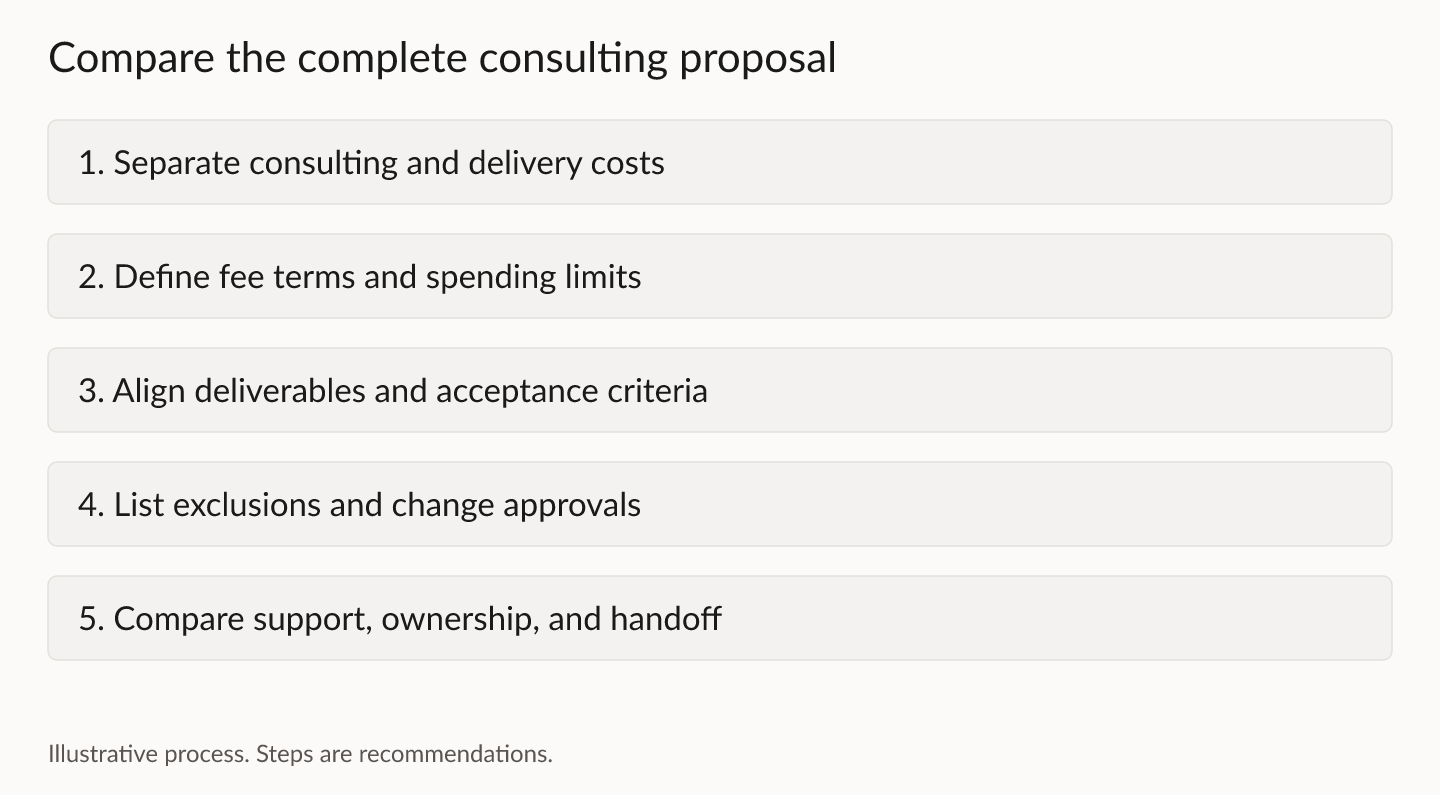
Compare fees alongside scope, exclusions, acceptance criteria, and ongoing responsibilities.
- Separate consulting and delivery costs
- Define fee terms and spending limits
- Align deliverables and acceptance criteria
- List exclusions and change approvals
- Compare support, ownership, and handoff