Who Offers AI Readiness Assessments for Mid-Market Companies?
Published . Updated .
ExecuSource Advisors, Density Labs, TIMIT Solutions, KOI AI, and GBQ Partners advertise AI readiness assessments. Compare their proposed scope, supporting evidence, deliverables, and follow-up terms before choosing. Their published offers provide starting points, not proof of delivery quality.
AI means artificial intelligence. A readiness assessment evaluates whether a company can deliver its proposed AI projects. This guide focuses on hiring an assessor, not running the assessment yourself. Use it to build a shortlist and request comparable proposals.
Which providers should you consider?
These examples are not rankings or recommendations. Confirm current prices, availability, and contract terms directly. Governance, mentioned below, means decision rights, policies, and oversight.
- ExecuSource Advisors: Its mid-market assessment covers data infrastructure, systems integration, governance, talent, and executive sponsorship. The page states, “We are platform-neutral.” It also discusses inspecting actual pipelines, integrations, and data quality for proposed projects. Ask which technical inspections your proposal includes.
- Density Labs: It advertises a two-week assessment, ranked workflow findings, capability and architecture gaps, and a 90-day plan. Its page lists a $7,500 standard fee and a $2,500 founding-cohort fee. Confirm eligibility and conditions before treating either figure as your price.
- TIMIT Solutions: Its assessment covers data, infrastructure, processes, organizational capability, leadership alignment, and governance. Listed outputs include an assessment report, maturity heatmap, prioritized roadmap, quick wins, and executive briefing. The heatmap visually summarizes strengths and gaps. Request its scoring method and supporting evidence.
- KOI AI: It advertises a two-week assessment “from $10K,” covering six dimensions and identifying 8–12 opportunities. Listed deliverables include return-on-investment estimates, risk scoring, a roadmap, executive briefing, and interview and analysis notes. Ask which assumptions support the financial estimates.
- GBQ Partners: Its AI Clarity page targets Microsoft 365 users with $25 million–$500 million in revenue. Its foundation assessment promises a “scored readiness report and a prioritized gap list.” It also describes separate risk, security, technology, data, and workforce assessments. Confirm which assessments your proposal includes.
How should you compare provider types?
Compare the engagement model, not just the firm's label. Ask whether the assessor also sells implementation, managed services, or a preferred technology platform. Those relationships deserve disclosure; they do not automatically disqualify a provider.
For an advice-only engagement, request findings another implementation team could use. For an assessment-plus-implementation proposal, separate assessment acceptance from later purchasing decisions. For a technology-specific assessment, ask which alternatives fall outside scope.
Use Chiri’s guide to whether AI consulting is worth it to frame the spending decision. Your immediate purchase should answer a defined business question, not commit you to an unspecified transformation program.
What evidence and deliverables should you request?
Start with your decision: approve a pilot, resolve a data constraint, or defer investment. Then ask each provider to connect its work to that decision. Chiri’s AI readiness assessment guide can help you frame the scope without replacing external diligence.
Request an evidence plan covering interviews, document review, data samples, and system inspection. Ask providers to distinguish observed findings from employee opinions and untested assumptions. Agree on access permissions, confidentiality, retention, and deletion before sharing company information.
Ask for a redacted sample report and the people who will perform the work. Look for traceable findings, prioritization criteria, dependencies, proposed owners, and explicit uncertainties. Require an explanation of each maturity score’s calculation and supporting evidence.
For regulated workflows, request relevant experience and clear review responsibilities. Chiri’s healthcare implementation provider guide offers related questions for healthcare buyers.
What should your comparison checklist include?
Send the same questions to every shortlisted provider:
- Scope: Which business priorities, systems, data, people, and governance questions will you assess?
- Evidence: What will you inspect, who will participate, and how will you record limitations?
- Outputs: Which reports, analysis notes, financial assumptions, and editable files will we receive?
- Commercial terms: What fee, timetable, exclusions, client workload, and acceptance criteria apply? Acceptance criteria define conditions for accepting the work.
- Follow-up: Who owns the work, what support follows, and can another firm implement the recommendations?
How should you make the final choice?
Prefer the proposal that makes its evidence, limitations, and handover obligations clearest. Ask for references from comparable engagements, while recognizing that references alone cannot establish your likely outcome. Avoid treating advertised speed or a low entry price as sufficient evidence of fit.
If ongoing operations enter the proposal, evaluate them separately. Chiri’s managed AI services provider guide offers related operational diligence questions. Buy a bounded assessment first, with explicit outputs and an independent decision about what happens next.
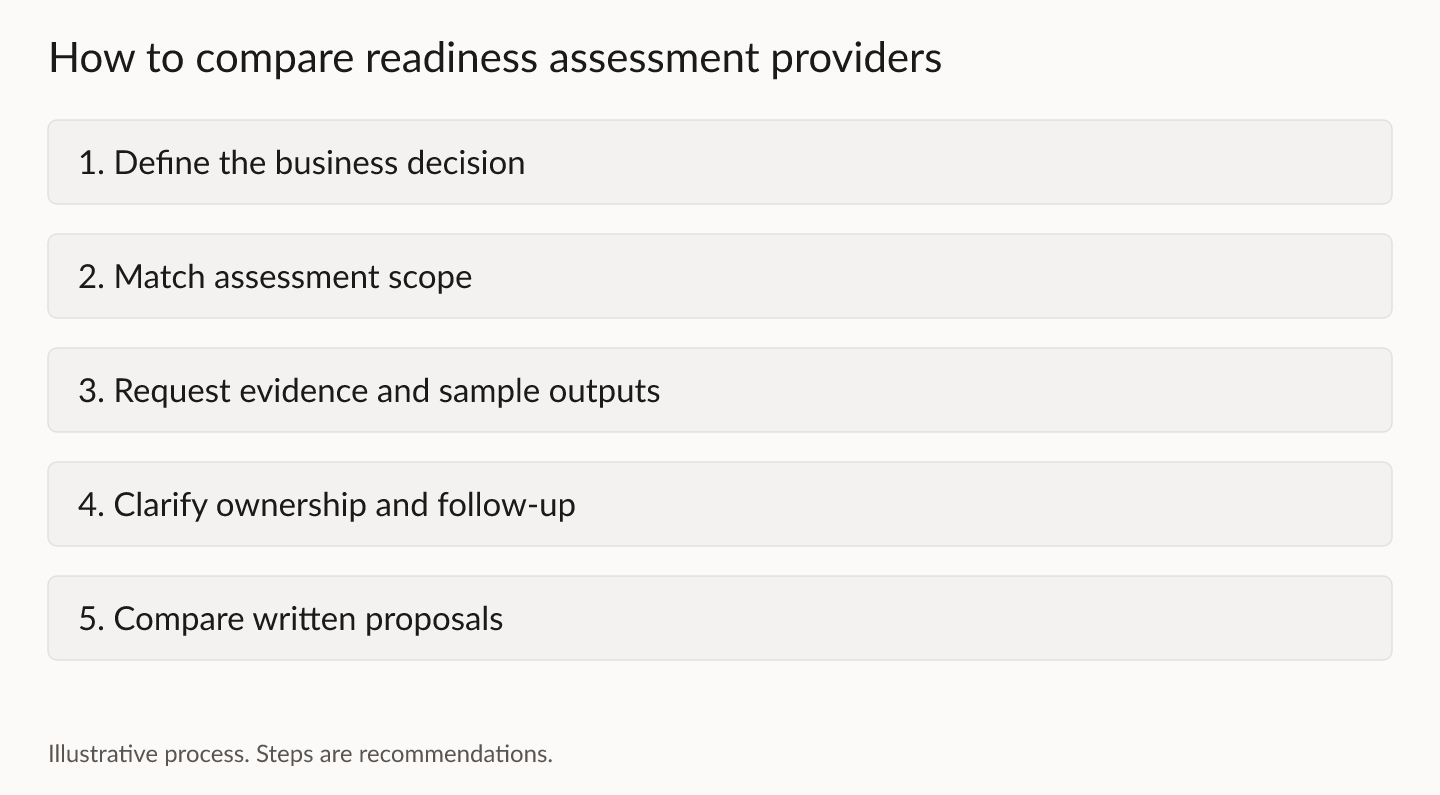
Compare scope, evidence, deliverables, and follow-up before choosing an assessment provider.
- Define the business decision
- Match assessment scope
- Request evidence and sample outputs
- Clarify ownership and follow-up
- Compare written proposals